
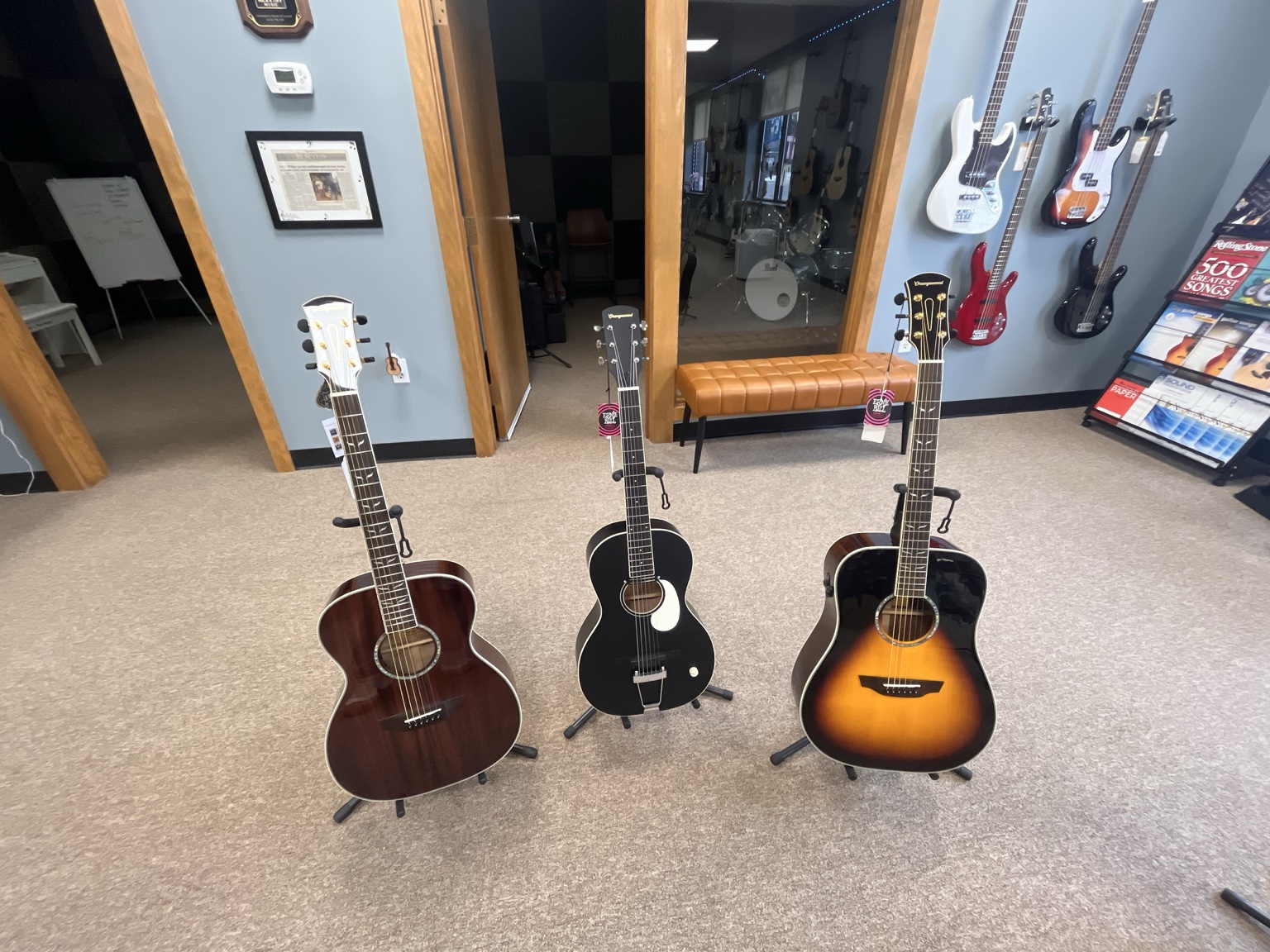
If you’re considering an Orangewood acoustic guitar, you’re probably asking the same question most players do:
Are Orangewood guitars actually good for the price?
Short answer: yes.
As an official Orangewood dealer at Nick & Tiff Music, we’ve seen firsthand how these guitars perform in real-world situations — from first-time players buying their very first acoustic to experienced musicians looking for a reliable gigging instrument.
Here’s our honest breakdown of what Orangewood does well, where they stand compared to other brands, and who they’re best for.
What Makes Orangewood Guitars So Good for the Price?
Orangewood built its reputation on delivering more guitar than you’d expect at the price point.
Across the models we carry, you’ll consistently find:
- Solid tops (the #1 feature that improves tone and resonance over time)
- Bone nuts & saddles (a premium upgrade rarely seen at this price)
- Comfortable neck profiles with modern playability
- Consistent craftsmanship and clean finishing
- High-quality gig bags with thick padding and backpack straps included
In our store, customers are often surprised by how “finished” these guitars feel right out of the box.
They don’t feel like budget instruments.
They feel intentional.
Pros and Cons of Orangewood Guitars
Let’s be honest — no guitar brand is perfect.
Pros
- Excellent value for money
- Solid tops on many entry models
- Comfortable, beginner-friendly necks
- Clean aesthetics and modern finishes
- Gig bag included (adds real value)
Cons
- Not as widely available as legacy brands
- Shorter long-term history compared to Yamaha or Fender
- Fewer ultra-high-end models in the lineup
For most beginners and intermediate players, the pros heavily outweigh the cons.
Orangewood vs Yamaha: Which Is Better for Beginners?
This is one of the most common comparisons we hear in the shop.
Yamaha has decades of reputation and proven reliability in the beginner market.
Orangewood competes by offering premium features (solid tops, bone components, included gig bags) at similar price points — often with more modern aesthetics.
If you prefer:
- Long-standing legacy reputation → Yamaha
- Modern value-focused design → Orangewood
Both are strong. But many players are surprised at how much Orangewood delivers once they actually play one.
Orangewood Models We Carry (Dealer Breakdown)
Here are a few models we regularly stock and recommend.
Orangewood Echo Live – Best All-Around Option
Top: Solid Sitka Spruce
Body Style: Dreadnought
Best For: Strumming, church gigs, open mics
The Echo Live surprises nearly everyone who picks it up.
It has clean projection, a responsive feel, and onboard electronics that sound warm and natural when plugged in. For the price, it feels like it should cost significantly more.
In-store, this is often the model beginners gravitate toward — and experienced players respect.

Orangewood Morgan Natural Burst Live – Comfortable & Balanced
Body Style: OM (slightly smaller than dreadnought)
Best For: Recording, lighter strumming, comfort
The Morgan is one of the most comfortable acoustics we carry.
Its slightly smaller body makes it easier to hold, while still delivering impressive clarity and volume. The Natural Burst finish looks incredible in person.
Players who want something versatile and easy to play often choose this one.

Orangewood Brooklyn Live – Bold & Full
Top: Solid Mahogany
Best For: Singer-songwriters, rhythm players
The Brooklyn Live has a bigger, fuller voice.
It projects strongly without becoming harsh, and the solid mahogany top gives it a warm, punchy character that works beautifully for singer-songwriters.
This is one we frequently recommend for players stepping slightly beyond the beginner stage.

Orangewood Juniper Rubber Bridge Live – Unique & Creative
Best For: Indie, alternative, recording
The Juniper Rubber Bridge is different in the best way.
It delivers that muted, vintage, lo-fi tone many artists are chasing right now. It’s inspiring in a completely different way from a standard acoustic.
For creative players, this one stands out.

Are Orangewood Guitars Good for Beginners?
Yes — especially for players who want:
- Comfortable neck profiles
- Modern playability
- Solid top tone without a high price tag
- A guitar that feels inspiring right away
Many beginners quit because their first guitar is hard to play.
Orangewood’s setup and playability tend to reduce that frustration significantly.
Where Are Orangewood Guitars Made?
Orangewood guitars are designed in California and built overseas in order to keep pricing accessible while maintaining strong quality control standards.
Their direct-to-player model helped them grow quickly, and they’ve since expanded into select dealer partnerships — including ours.
Final Verdict: Are Orangewood Guitars Worth It?
For beginner and intermediate players, absolutely.
They deliver premium features at accessible prices, feel great in the hands, and consistently surprise people when compared side-by-side with similarly priced competitors.
Are they the only good option on the market?
No.
But they’re one of the strongest value plays in their price range.
Ready to try one in person?
Try Orangewood Guitars at Nick & Tiff Music
All Orangewood models featured here are available to try in person at:
Nick & Tiff Music
6840 Erie Rd (Route 5)
Derby, NY 14047
📞 716-255-9837
We are an official Orangewood guitar dealer serving Derby, NY and the greater Buffalo area.
Whether you’re a beginner or an experienced player, we’re happy to help you find the right acoustic guitar.
Come in, give one a strum, and hear the difference for yourself.
Orangewood Guitar Review: Our Honest Dealer Experience
Frequently Asked Questions About Orangewood Guitars
Are Orangewood guitars good for beginners?
Yes. Their comfortable neck profiles, solid tops, and consistent setup make them beginner-friendly and easy to play.
Do Orangewood guitars hold their value?
Like most entry-to-mid acoustic brands, resale depends on condition, but solid top models tend to hold value better.
Are Orangewood guitars made in the USA?
Orangewood guitars are designed in California and built overseas to maintain affordability.
Is Orangewood better than Fender?
In the beginner range, Orangewood often includes higher-end features at similar price points, but both brands offer strong options.
Compared to entry-level Fender acoustics, Orangewood models often include solid tops and upgraded appointments at similar price points.
Join the conversation, leave a comment, or if you’re a subscriber and would rather reply directly, just hit reply to the email. I read every message.
🎶 Enjoy This Post?
Get our Weekly Music Discussions delivered straight to your inbox — album deep dives, playlists, and local music news.
More From Nick & Tiff Music Blog
Best Beginner Acoustic Guitars Under $300 (2026 Buyer’s Guide)
Our Music Blog: A Relaxing Place for Thoughtful Music Reading
When Should You Really Change Your Guitar Strings?
Dixon Spark Drum Sets: Beginner-Friendly, Intermediate-Ready
Oasis – (What’s the Story) Morning Glory? (1995) Album Review #3
The Tragically Hip: The Most Underrated Rock Band of All Time
“Going to California” (1971) Meaning & Song Review – Led Zeppelin
Artist Spotlight #9: Billy Strings
Check out our Gear Talk & Store Happenings page where you can find all of our Store updates…
Gear Talk & Store Happenings | Nick & Tiff Music Blog
Explore all of our music writing on our HOMEPAGE
Nick & Tiff Music Blog – ALBUM REVIEWS – WEEKLY PLAYLISTS – GEAR TALK


Leave a Reply