
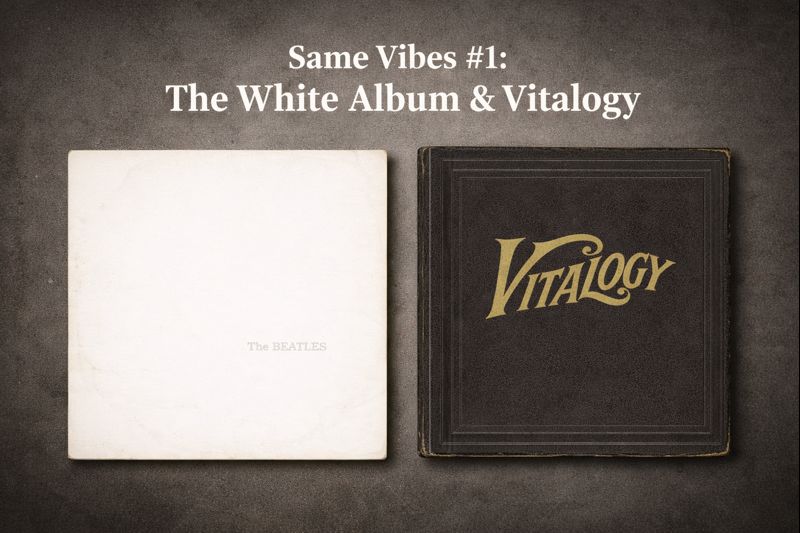
Different artists. Same headspace.
Same Vibes explores the shared emotional DNA between albums and artists. In this first entry, we look at The Beatles’ White Album and Pearl Jam’s Vitalogy, two restless records shaped by pressure, fame, and a refusal to simplify.
Why I Think These Two Albums Have the Same Vibe
At first glance, pairing The White Album with Vitalogy might feel unexpected. One is a sprawling double LP from the most famous band on Earth; the other is a restless, confrontational record released by a band trying to survive its own fame. But listen closely, and the connection becomes undeniable.
These are albums made under pressure — records that sound fractured not because the artists lost control, but because they refused to pretend everything was fine.
Both albums capture bands at a breaking point, choosing instinct over cohesion and truth over comfort.
Get weekly album deep dives, playlists, and local music news — delivered free.
IMPORTANT:
After subscribing, check your Spam, Junk, or Promotions folder
for a confirmation email from Nick & Tiff Music and click confirm.
Move it to your inbox so you don’t miss future posts.
Context Without the Timeline
By 1968, The Beatles were no longer functioning as a unified group in the traditional sense. Personal growth, creative ambition, and philosophical differences had pulled them inward. Instead of hiding that fracture, they documented it.
By 1994, Pearl Jam were wrestling with a different kind of pressure: massive success, media scrutiny, and an industry machine they openly distrusted. Vitalogy arrived as a deliberate act of resistance — confusing, confrontational, and uninterested in mass appeal.
Neither band was trying to make a “safe” album. Both were trying to survive themselves.
Sound as Psychology
What links these albums most strongly isn’t genre or era — it’s emotional architecture.
The White Album
- Wildly eclectic
- Abrupt tonal shifts
- Songs feel isolated, even when sequenced together
- Minimalism sits beside chaos
Vitalogy
- Jarring transitions
- Songs bleed into noise, experiments, and detours
- Abrasive moments sit next to moments of real beauty
- Intentionally disorienting
In both cases, the listening experience mirrors the mental state of the artists: restless, impatient, searching.
These albums don’t guide you — they confront you.
Support the Blog: These links help support Nick & Tiff Music at no extra cost to you… If you purchase anything after clicking one, even if it’s not the exact item listed, we still receive a small credit — and we truly appreciate it!
Explore The White Album on Amazon
Parallel Moments: Different Songs, Same Headspace
While The White Album and Vitalogy rarely sound alike on the surface, certain songs from each record occupy the same emotional space — moments where vulnerability, tension, and discomfort take center stage.
Rejection of False Authority
- Sexy Sadie
- Not for You
Both songs confront systems that claim influence without accountability. Sexy Sadie exposes spiritual hypocrisy; Not for You pushes back against the commercial machinery that seeks to package meaning and access. Neither song is interested in reconciliation — they simply withdraw belief and move on.
Fragility & Emotional Exposure
- Julia
- Nothingman
Both songs feel almost unguarded. Julia is hushed and intimate, barely raising its voice, while Nothingman carries quiet devastation beneath its restraint. Neither song asks for attention — they simply exist, heavy with personal weight.
Exhaustion & Withdrawal
- I’m So Tired
- Corduroy
Both songs capture artists worn down by attention rather than fueled by it. I’m So Tired is blunt and mentally drained, expressing frustration without theatrics. Corduroy channels a similar exhaustion, written in response to the growing obsession over Eddie Vedder’s appearance, words, and perceived meaning. The line “I’d give you everything I got for a little piece of mind” from I’m So Tired seems to be exactly what Eddie Vedder is expressing in Corduroy. Neither song explodes — they endure. The tension comes from fatigue, from artists trying to reclaim a sense of self amid constant scrutiny.
Isolation, Mortality & Emotional Weight
- Yer Blues
- Immortality
Yer Blues is one of John Lennon’s starkest admissions of loneliness, written during a period of intense personal turmoil. Its exaggerated despair masks something very real — a sense of isolation so overwhelming it borders on a desire to disappear.
Immortality carries a similarly heavy emotional weight. While Pearl Jam have never definitively stated its meaning, many listeners have long interpreted the song through the lens of Kurt Cobain’s death, hearing it as a meditation on the cost of fame and the danger of being turned into a symbol rather than a person.
What connects these songs isn’t biography alone, but their emotional gravity. Both sit with the idea of mortality, detachment, and the loneliness that can come with being seen but not truly known.
Disruption as Statement
- Wild Honey Pie
- Bugs
Often dismissed as oddities, these tracks actually reinforce the albums’ intent. They interrupt flow, challenge patience, and reject traditional structure — reminding the listener that these records were never meant to be comfortable.
Beauty, Restraint & Enduring Popularity
- Blackbird
- Better Man
Both Blackbird and Better Man stand out as some of the most widely loved and enduring songs on otherwise challenging albums. Each is built around restraint — simple arrangements, strong melodies, and performances that prioritize feeling over volume.
Their popularity isn’t accidental. These songs are immediate without being shallow, emotionally resonant without being dramatic. They offer moments of warmth and clarity within albums that often feel tense or unsettled, reminding listeners that beauty and accessibility can coexist with artistic risk.
The Misunderstanding
Both records were, and still are, misunderstood in similar ways.
- Too messy
- Too inconsistent
- Self-indulgent
- Hostile
But that criticism misses the point.
These albums aren’t trying to be seamless statements. They are documents of fracture, and their rough edges are the point. They challenge the idea that greatness must always be polished or unified.
Songs as Breaking Points
These albums thrive in moments that challenge expectations:
- Songs that feel intentionally unresolved
- Tracks that interrupt momentum rather than build it
- Experiments that test comfort without abandoning intent
Those moments are where the truth lives.
They reflect artists pushing back against expectation — from the audience, the press, and even themselves.
Disruption as Intent
Both albums include moments that step outside traditional song form: Revolution 9 and Hey Foxymophandlemama, That’s Me, also known as Stupid Mop.
Rather than serving as conclusions or summaries, these tracks act as statements. Revolution 9 is carefully assembled from loops, voices, and repetition, creating an unsettling but deliberate internal logic. Stupid Mop, built around repetition and atmosphere, feels less like a song and more like an emotional residue left behind.
Neither track exists to shock for shock’s sake. They challenge expectations, expand what belongs on a rock album, and underline the restless mindset that defines both records.
In both cases, experimentation isn’t a detour — it’s part of the point.
Legacy Over Time
What’s fascinating is how both albums have aged.
Decades later, The White Album is celebrated not despite its chaos, but because of it. It’s seen as a fearless snapshot of creativity unfiltered.
Vitalogy has undergone a similar reevaluation. What once felt alienating now feels honest — a band refusing to turn itself into a product.
In hindsight, both albums feel necessary.
They mark moments when artists chose authenticity over approval.
Same Vibes, Different Voices
The White Album and Vitalogy don’t sound alike — but they feel alike.
They live in the same emotional space:
- Creative tension
- Internal conflict
- Refusal to simplify
- Courage to document discomfort
These are albums made by artists who didn’t know exactly where they were going — only that they couldn’t stay where they were.
That shared instinct is what connects them.
What do these albums mean to you? — share your thoughts in the comments, or if you’re a subscriber and would rather reply directly, just hit reply to the email. I read every message.
Here’s a link to our Homepage where you can find all of our posts, including pieces on The Beatles, Pearl Jam, The Rolling Stones, and More…
Nick & Tiff Music Blog – ALBUM REVIEWS – WEEKLY PLAYLISTS – GEAR TALK
If you liked this piece, you might enjoy our weekly album deep dives and playlists. You can subscribe below – it’s free.
 Nick & Tiff Music Blog
Leave a comment