
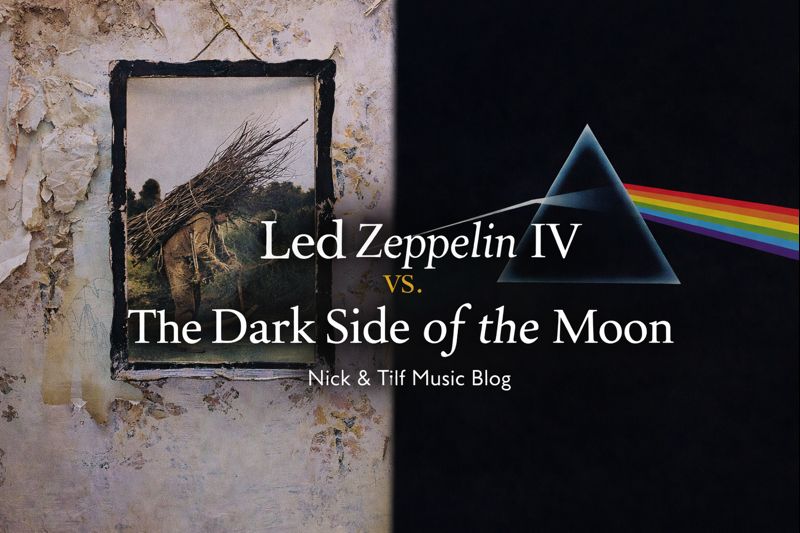
Two Albums That Defined Rock—In Completely Different Ways
There are very few albums in rock history that feel inevitable—records so powerful, so complete, that once they exist, it’s impossible to imagine the genre without them. Led Zeppelin IV and The Dark Side of the Moon are two of those albums.
Released less than two years apart, they didn’t just dominate the charts—they redefined what a rock album could be. One is rooted in mysticism, blues, and primal power. The other is a sonic meditation on time, madness, and the human condition. Both are flawless in their own way, yet they could not be more different.
This isn’t about choosing a winner. It’s about understanding why these albums still matter more than fifty years later.
Get weekly album deep dives, playlists, and local music news — delivered free.
Led Zeppelin IV: Power, Myth, and Timeless Rock
Led Zeppelin’s fourth album famously arrived with no title and no band name on the cover—a bold statement that said the music would speak for itself. And it did.
From the opening punch of “Black Dog” to the closing drive of “When the Levee Breaks,” Led Zeppelin IV is a masterclass in dynamics. It blends thunderous hard rock, deep blues, and pastoral folk into a sound that feels ancient and modern at the same time.
At the center of it all is “Stairway to Heaven,” a song so iconic it’s almost unfair to the rest of the album. But what often gets overlooked is how earned that song feels within the album’s flow. It rises slowly, organically—just like the record itself.
Jimmy Page’s guitar work is muscular yet elegant, John Bonham sounds like he’s playing with the weight of the earth behind him, John Paul Jones adds subtlety and texture, and Robert Plant’s vocals carry a mythic sense of longing. This is rock music that feels bigger than the people who made it.
Led Zeppelin IV doesn’t explain itself. It invites you in and lets you find your own meaning—and that mystery is part of why it still feels alive.
Explore more Led Zeppelin discussions, song meanings & reviews here.
Support Nick & Tiff Music: As an affiliate these links support the blog at no extra cost to you – and we truly appreciate it! Thank you for supporting.
Shop Led Zeppelin Vinyl, CDs, Books, & Merch
Buy Led Zeppelin IV on Vinyl & CD
Shop Pink Floyd Vinyl, CDs, Books, & Merch
Buy Dark Side of the Moon on Vinyl & CD
The Dark Side of the Moon: Sound, Space, and the Human Experience
If Led Zeppelin IV is elemental, Pink Floyd’s The Dark Side of the Moon is cerebral.
This album isn’t just a collection of songs—it’s a single, uninterrupted experience. From the heartbeat that opens “Speak to Me” to the quiet fade of “Eclipse,” everything is intentional. Every sound effect, every lyric fragment, every musical transition serves the larger theme: time, money, fear, mortality, and mental health.
Tracks like “Time,” “Us and Them,” and “Brain Damage” don’t just resonate—they linger. David Gilmour’s guitar doesn’t overwhelm; it speaks. Richard Wright’s keyboards create emotional space. Nick Mason’s drumming is precise and patient. Roger Waters’ lyrics are stark, honest, and unsettling in their relatability.
What makes Dark Side so remarkable is that it manages to be deeply philosophical without ever feeling cold. It’s introspective but accessible, experimental yet inviting. That balance is why it became one of the best-selling albums of all time—and why it still sounds shockingly modern.
Explore more Pink Floyd discussions, song meanings & reviews here.
Rock vs. Reflection
Here’s where the real contrast lives.
Led Zeppelin IV is about power and possibility. It feels rooted in folklore and instinct. It’s meant to be played loud, shared with friends, and felt in your chest.
The Dark Side of the Moon is about reflection and awareness. It turns inward. It asks you to listen closely, preferably alone, and confront uncomfortable truths about life and time slipping away.
One album expands outward. The other pulls you inward. Both accomplish exactly what they set out to do.
Jimmy Page vs. David Gilmour: Two Guitar Voices, Two Philosophies
At the heart of what separates Led Zeppelin IV and The Dark Side of the Moon are two of the most iconic guitarists in rock history—Jimmy Page and David Gilmour—whose approaches could not be more different, yet are equally essential.
Jimmy Page’s guitar work on Led Zeppelin IV is rooted in power, texture, and unpredictability. His riffs feel ancient and physical, pulling from blues, folk, and hard rock with a looseness that gives the music its raw edge. Whether it’s the snarling swagger of “Black Dog,” the acoustic intimacy of “Going to California,” or the slow-burning ascent of “Stairway to Heaven,” Page plays like someone chasing a feeling rather than perfection.
David Gilmour, on the other hand, is a master of restraint and emotional clarity. His solos on The Dark Side of the Moon aren’t about speed or density—they’re about space. Every note is chosen, every bend deliberate. On tracks like “Time” and “Money,” Gilmour’s guitar doesn’t demand attention; it invites it, allowing emotion to unfold slowly and linger long after the song ends.
Page’s guitar feels like a force of nature—sometimes wild, sometimes dangerous. Gilmour’s feels like a voice—calm, patient, and deeply human. One overwhelms you with energy. The other draws you inward.
Together, they represent two completely valid—and equally timeless—ways of using the guitar as a storytelling instrument.
Legacy and Influence
It’s hard to overstate the impact of either album.
Led Zeppelin IV became the blueprint for hard rock and heavy metal bands that followed. Its influence can be heard in everything from classic rock radio staples to modern blues-based rock revivalists.
The Dark Side of the Moon changed how albums were conceived. It paved the way for concept records, immersive production techniques, and the idea that a rock album could be a unified emotional journey rather than a set of singles.
Together, they represent two peaks of creativity—proof that rock music can be both primal and profound.
Try and catch some of the best Led Zeppelin & Pink Floyd Tribute bands around:
See Get The Led Out Tour Dates & Tickets
See Letz Zep Tour Dates & Tickets
See Led Zepagain Tour Dates & Tickets
See Brit Floyd Tour Dates & Tickets
See The Australian Pink Floyd Show Tour Dates & Tickets
See The Machine Tour Dates & Tickets
Final Thoughts
If Led Zeppelin IV is the sound of climbing a mountain, The Dark Side of the Moon is the view from the top when you finally stop and look around.
They don’t compete—they coexist. And that’s why debates about them never really end. Each album meets the listener where they are, and what you gravitate toward often says as much about you as it does the music.
Some nights call for thunder. Others call for reflection. Rock music is lucky enough to have both.
Like, comment, or share — and let us know your take in the comments, or if you’re a subscriber and would rather reply directly, just hit reply to the email. I read every message.
If this piece resonated with you, consider sharing it with a friend who might appreciate it too. That kind of word-of-mouth support really helps the blog grow, and we’re grateful for it.
Browse our posts by Bands & Artists
Bands & Artists | Explore Music Coverage by Artist – Nick & Tiff Music Blog
Related Reads
Time – Meaning & Song Review – Pink Floyd
Have a Cigar – Meaning & Song Review – Pink Floyd (1975)
Welcome to the Machine Meaning & Song Review – Pink Floyd (1975)
Same Vibes #12: “Serve the Servants” (Nirvana) & “Welcome to the Machine” (Pink Floyd)
What Is the Best Led Zeppelin Album? Exploring the Band’s Greatest Records
Led Zeppelin III Album Review #25: Zeppelin’s Bold Change of Direction
Going to California Meaning: The Story Behind Led Zeppelin’s Acoustic Masterpiece
Stairway to Heaven Lyrics Meaning: What Led Zeppelin’s Song Is Really About
What Is “When the Levee Breaks” About? Led Zeppelin Lyrics Meaning Explained
Black Dog Lyrics Meaning: Led Zeppelin’s Song About Desire and Regret
Kashmir – Meaning & Song Review – Led Zeppelin (1975)
Over the Hills and Far Away (1973) Meaning & Song Review – Led Zeppelin
The Ocean Lyrics Meaning: What Is Led Zeppelin’s “The Ocean” About?
Ramble On (1969) – Meaning & Song Review – Led Zeppelin
Heartbreaker Lyrics Meaning: Led Zeppelin’s Explosive Song About Betrayal and Desire
Immigrant Song (1970) – Meaning & Song Review – Led Zeppelin
Good Times Bad Times – Meaning & Song Review – Led Zeppelin (1969)
Tangerine Lyrics Meaning: Led Zeppelin’s Breakup Song Explained
Gallows Pole Meaning: Led Zeppelin’s Dark Folk Story Explained
That’s the Way Lyrics Meaning: Led Zeppelin’s Song About Lost Innocence
The 10 Most Underrated Beatles Songs (In Chronological Order)
The Most Underrated Beatles Songs – Part 2 (11-20) (In Chronological Order)
The 10 Most Underrated Rolling Stones Songs (In Chronological Order)
The 10 Most Underrated Pearl Jam Songs (In Chronological Order)
Mama Kin – Aerosmith Song Review
Same Vibes #2: Lennon & Cobain
This piece is part of our Weekly Music Discussion, check out our page where we have all sorts of fun conversations and discuss all things Music
Weekly Music Discussion | Nick & Tiff Music Blog
If you liked this piece, you might enjoy our weekly album deep dives and playlists. You can subscribe below – it’s free.
Here’s a link to our Homepage where you can find all of our posts
Nick & Tiff Music Blog – ALBUM REVIEWS – WEEKLY PLAYLISTS – GEAR TALK
Leave a Reply