
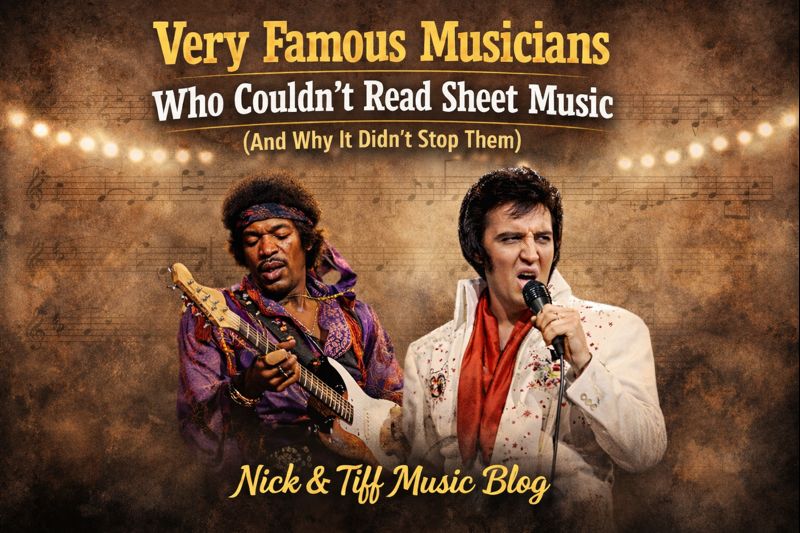
One of the biggest misconceptions in music is that you need to know how to read sheet music to be a good musician.
This simply isn’t true.
Reading sheet music is a valuable skill, and for many musicians it’s an essential part of their journey. But it’s important to understand this truth:
Not being able to read sheet music will not stop you from becoming a great musician.
In fact, some of the most famous and influential musicians of all time built legendary careers without ever relying on traditional notation.
Music Has Never Been One-Size-Fits-All
Music has always been learned in different ways.
Long before textbooks, apps, and theory classes, musicians learned by:
- Listening
- Copying what they heard
- Playing with others
- Developing feel and instinct
Even today, there are countless paths into music. Some musicians thrive in band or orchestra settings with sheet music in front of them. Others learn entirely by ear, tabs, muscle memory, and repetition.
Neither path is “better.”
They’re just different.
Very Famous Musicians Who Couldn’t Read Sheet Music
Here are just a few iconic artists who prove that reading sheet music is not a requirement for musical greatness:
Jimi Hendrix
Often cited as one of the greatest guitarists of all time, Hendrix was largely self-taught. He learned by ear, experimentation, and feel. His deep understanding of music came from listening and playing — not from written notation.
Paul McCartney
McCartney famously couldn’t read or write traditional sheet music for much of his career. Many Beatles songs were composed by humming melodies, experimenting on instruments, and later having others help translate those ideas into notation.
You can explore more of our Beatles coverage here.
Eric Clapton
Clapton has openly discussed struggling with reading music. His mastery of the blues came from listening closely, absorbing phrasing, and developing his own voice on the guitar.
Dave Grohl
Self-taught on drums and guitar, Grohl learned by playing along with records and jamming with others. His musical instincts and energy helped shape bands like Nirvana and Foo Fighters.
You can explore more of our Foo Fighters coverage here.
Elvis Presley
Elvis couldn’t read music at all. His power came from emotion, phrasing, and delivery — not from sheet music. Yet his influence on modern music is immeasurable.
Eddie Van Halen
Van Halen had minimal traditional reading skills and relied heavily on experimentation and feel. Many of his groundbreaking techniques came from simply asking, “What happens if I try this?”
So… Is Reading Sheet Music Helpful?
Absolutely.
Learning to read music can:
- Open doors in school band and orchestra
- Make it easier to communicate with other musicians
- Help with structured environments like ensembles, pit orchestras, and session work
For many students, especially those in school programs, reading music is an important and valuable skill — and one we absolutely encourage.
But here’s the key takeaway:
Helpful does not mean required.
Why Not Reading Sheet Music Won’t Hold You Back
Many musicians build incredible careers by focusing on:
- Playing by ear
- Developing strong listening skills
- Learning chord shapes, tabs, and progressions
- Writing songs through feel and emotion
In genres like rock, blues, folk, punk, indie, and singer-songwriter music, feel often matters more than formal notation.
Some musicians eventually learn theory later. Some never do. And both paths are valid.
What matters most is that you:
- Keep playing
- Keep listening
- Keep enjoying music
The Most Important Thing: Don’t Quit
One of the hardest things for young musicians — especially beginners — is feeling like they’re “behind.”
They’re not.
Music isn’t about perfection or checking boxes. It’s about expression, connection, and joy. If you love playing, singing, or writing music, that alone means you’re doing something right.
If you want to learn to read music, that’s amazing.
If you don’t, that’s okay too.
The only real mistake is letting fear stop you from playing at all.
Final Thoughts
Some of the greatest musicians in history followed traditional paths.
Some didn’t.
Both changed the world through music.
Wherever you are on your journey, keep going — because music needs all kinds of players.
💬 Who’s your favorite musician who learned outside the traditional rules?
Let us know — we’d love to hear your story.
Nick & Tiff Music
6840 Erie Rd, Derby, NY 14047
As always, thanks for supporting local music and local musicians.
More From Nick & Tiff Music Blog
School Instrument Rentals Made Easy | Month-to-Month Rentals at Nick & Tiff Music
Music for Minis: Our Intro to Music Kids Class Is Back!
Best Beginner Acoustic Guitars Under $300 (2026 Buyer’s Guide)
When Should You Really Change Your Guitar Strings?
Why Melody Is the Most Powerful Tool in Songwriting
It’s Okay to Like Whatever Music You Like
The 10 Most Underrated Beatles Songs (In Chronological Order)
The 10 Most Underrated Rolling Stones Songs (In Chronological Order)
Going to California (1971) Meaning & Song Review – Led Zeppelin
Yellow Ledbetter (1992) Meaning & Song Review – Pearl Jam
Artist Spotlight #9: Billy Strings
Browse our posts by Bands & Artists:
Bands & Artists | Explore Music Coverage by Artist – Nick & Tiff Music Blog
Check out our Gear Talk & Store Happenings page where you can find all of our Store updates:
Gear Talk & Store Happenings | Nick & Tiff Music Blog
If you found this helpful and want to hear about future clinics, repairs, and music features, this is the best way stay updated, and it’s free…
Here’s a link to our Homepage where you can find all of our posts, including pieces on The Beatles, Pearl Jam, The Rolling Stones, and More…
Nick & Tiff Music Blog – ALBUM REVIEWS – WEEKLY PLAYLISTS – GEAR TALK


Leave a Reply