
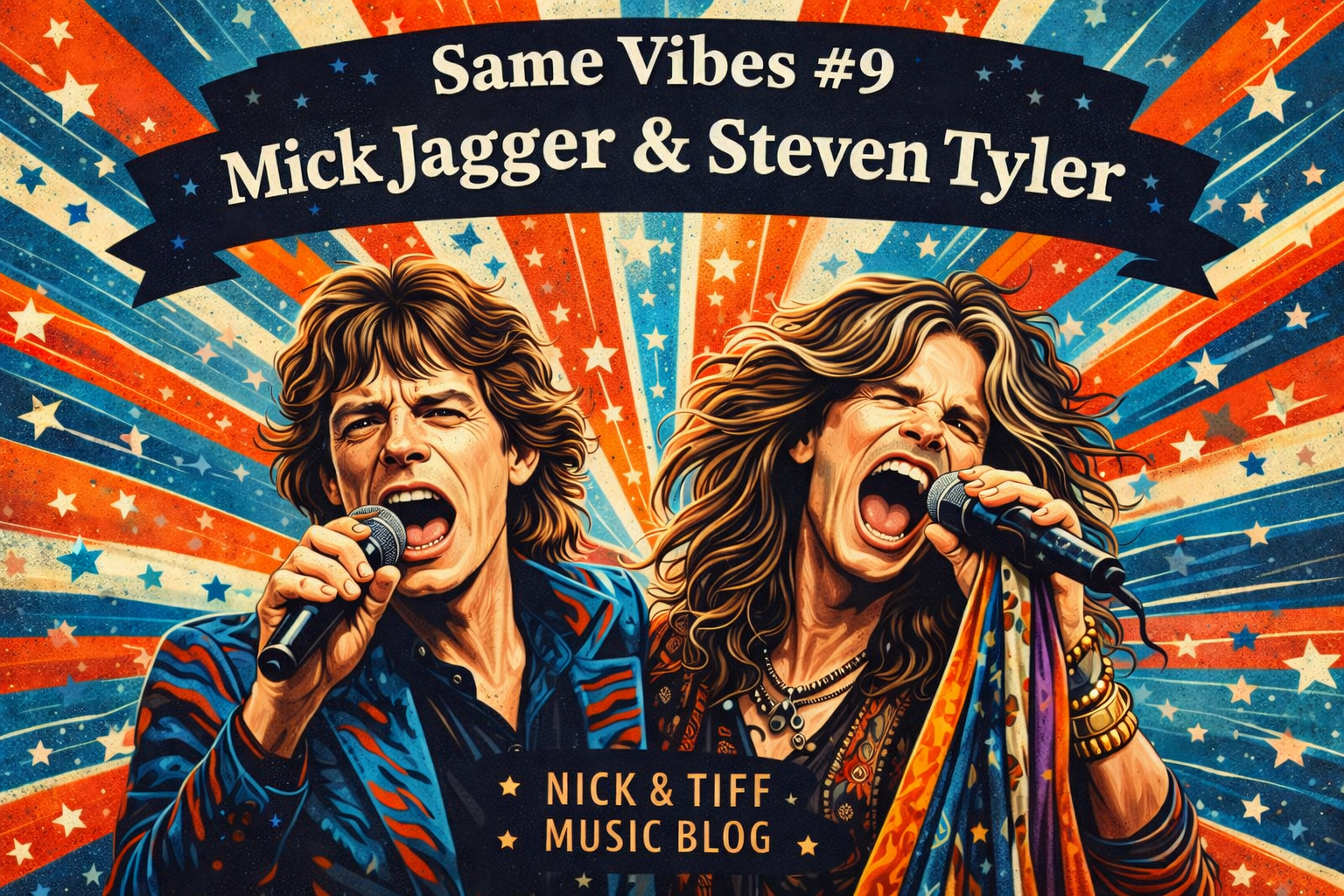
The Swagger, The Strut, and The Blueprint for Generations of Rock Frontmen
Some frontmen sing songs.
Some frontmen perform songs.
And then there are the rare ones who become the show.
Mick Jagger and Steven Tyler aren’t just lead singers — they’re living embodiments of rock star charisma. Different eras. Different bands. Same electricity.
This is Same Vibes #9.
You can explore more of our Rolling Stones coverage here.
And more Aerosmith coverage here.
The Strut
You can spot it instantly.
The movement.
The hips.
The exaggerated gestures that somehow never feel forced.
Jagger perfected the rock frontman strut in the 1960s with The Rolling Stones — a blend of blues swagger, rhythm & blues sensuality, and a little bit of danger. He didn’t just stand at the mic. He worked the stage.
Tyler picked up that torch in the 1970s with Aerosmith. Long scarves on the mic stand. Arms flailing. Screaming into the rafters. Twisting, spinning, prowling.
Neither of them ever looked like they were just singing.
They looked like they were possessed by the music.
The Voice: Grit Meets Glamour
Mick Jagger’s voice has that unmistakable sneer — elastic, bluesy, rhythmically sharp. It’s not traditionally “pretty,” but it’s expressive and instantly identifiable.
Steven Tyler? Raw, elastic, piercing. A high-wire act between scream and melody. He can go from a gritty blues howl to a soaring ballad chorus without losing personality.
Both vocalists:
- Stretch syllables.
- Bend notes.
- Inject attitude into every line.
- Sound like they’re half-laughing, half-threatening, half-seducing.
You don’t just hear them.
You feel them.
The Band Dynamic
Jagger and Tyler share another Same Vibes trait:
They front bands rooted in blues rock.
The Rolling Stones built their identity on American blues — Muddy Waters swagger filtered through British attitude. Their early records weren’t just inspired by the blues — they were immersed in it.
Aerosmith carried that same blues backbone into the 1970s, adding harder edges and bigger theatrics — but the foundation was the same.
Keith Richards’ guitar work defines so much of the Stones’ groove. Joe Perry’s riffs are the backbone of Aerosmith’s biggest hits.
Both bands understand something fundamental:
The blues isn’t just a style. It’s an attitude.
The singer isn’t the whole story — but they are the lightning rod.
They turn blues-rooted riffs into cultural moments.
The Glam, The Chaos, The Longevity
Both men became larger-than-life cultural figures.
- Scandals.
- Fashion statements.
- Magazine covers.
- Reinventions.
They survived changing decades — from gritty blues rock to arena rock to MTV to legacy-act stadium tours.
Jagger remained sharp and kinetic into his later years.
Tyler blended blues-rock swagger with mainstream crossover moments.
Different paths. Same resilience.
Where It Meets the Music
It’s easy to compare the swagger.
But the real Same Vibes shows up when you line up the songs.
1. Attitude-Driven Riff Anthems
Brown Sugar – The Rolling Stones
Walk This Way – Aerosmith
Both songs explode out of the speakers with pure confidence.
“Brown Sugar” is built on swagger — Jagger spits the lyrics with a rhythmic bite that almost feels percussive.
“Walk This Way” struts just as hard. Tyler doesn’t just sing the verses — he slides through them, snapping syllables in a way that practically invented a vocal style.
Different riffs. Same attitude.
2. Sleaze Meets Groove
Honky Tonk Women – The Rolling Stones
Sweet Emotion – Aerosmith
Loose. Dirty. Cool without trying too hard.
Jagger leans into the groove of “Honky Tonk Women” like he owns it.
Tyler does the same in “Sweet Emotion,” stretching words, sneering through verses, then exploding into the chorus.
Both singers understand something critical:
Sometimes the coolest thing you can do is not rush the groove.
3. Vulnerability Without Losing Swagger
Angie – The Rolling Stones
You See Me Crying – Aerosmith
This is where the comparison gets deeper.
Both frontmen built their reputations on swagger, movement, and attitude — but neither stayed one-dimensional.
On “Angie,” Jagger dials everything back. The delivery is controlled and almost weary, leaning into heartbreak without theatrics. There’s restraint in his phrasing, a quiet ache that carries the song.
“You See Me Crying” shows a similar shift from Tyler. Instead of strutting, he pleads. The orchestration swells, the emotion rises, and his voice cracks in places that feel real rather than polished. It’s dramatic, yes — but it’s wounded, not flashy.
Neither performance sacrifices presence.
They don’t lose it. They reshape it.
Different tones. Same courage to let the guard down.
4. Stadium Command
Start Me Up – The Rolling Stones
Love in an Elevator – Aerosmith
By the time both bands hit the 80s, they weren’t just rock bands — they were institutions.
“Start Me Up” is arena-ready confidence.
“Love in an Elevator” is theatrical, loud, and unapologetically fun.
Both singers sound like they were born to command 50,000 people at once.
Support Nick & Tiff Music: As an affiliate these links help support the blog at no extra cost to you — and we truly appreciate it! Thank you for supporting.
Shop Rolling Stones Vinyls, CDs, & Merch
And when you zoom out, that’s where the connection becomes undeniable.
The Real Same Vibes
Mick Jagger moves like rhythm.
Steven Tyler moves like electricity.
But in the songs — in the phrasing, the attitude, the elasticity of their voices — you hear the shared DNA.
Blues roots.
Showman instincts.
Frontman confidence that borders on reckless.
Different decades.
Same strut.
Why This Is Same Vibes
It’s not about copying.
It’s about archetypes.
Mick Jagger helped create the modern rock frontman template:
- Sexual energy.
- Physical movement.
- Charisma over perfection.
- Attitude over polish.
Steven Tyler took that template and amplified it:
- Higher screams.
- Bigger theatrics.
- More flamboyant flair.
If Jagger is the blueprint, Tyler is the high-voltage remix.
The Verdict
When you think of rock star swagger — the hips, the scarves, the smirk, the scream — you’re thinking of the DNA that runs through both of them.
They don’t just sing rock music.
They are rock music.
Who do you think carries the swagger torch today? Let us know in the comments.
If this piece resonated with you, consider sharing it with a friend who might appreciate it too. That kind of word-of-mouth support really helps the blog grow, and we’re grateful for it.
Explore more by Artist.
Bands & Artists | Explore Music Coverage by Artist – Nick & Tiff Music Blog
Related Reads
Toys in the Attic Album Review #26: Why This Is One of Aerosmith’s Best Albums
The Real Meaning Behind “Mama Kin” by Aerosmith (Song Review)
Back in the Saddle Lyrics Meaning: Aerosmith’s Bold Return to Power
Last Child Lyrics Meaning: Aerosmith Questioning the Life They’re Living
You See Me Crying Lyrics Meaning: Aerosmith’s Misunderstood Heartbreak
No More No More Lyrics Meaning: Aerosmith’s Song About Rock and Roll Excess and Burnout
What Is The Best Rolling Stones Album? Here’s What Each One Does Best
The 10 Most Underrated Rolling Stones Songs (In Chronological Order)
The Most Underrated Rolling Stones Songs – Part 2 (11–20) (In Chronological Order)
In The Stars by The Rolling Stones Meaning: Fate, Luck, and Stones Swagger
Rough and Twisted by The Rolling Stones Meaning: New Stones With A Classic Stones Sound
Sympathy for the Devil Meaning: The Rolling Stones’ Song About Blame, Evil, and Human Responsibility
Shattered Lyrics Meaning: The Rolling Stones’ Take on NYC in the 70s
Jumpin’ Jack Flash Lyrics Meaning: The Rolling Stones Turn Struggle Into Swagger
100 Years Ago Lyrics Meaning: The Rolling Stones Song About Growing Older
Paint It Black (1966) – Meaning & Song Review – The Rolling Stones
Beast of Burden (1978) – Meaning & Song Review – The Rolling Stones
Gimme Shelter (1969) Meaning & Song Review – The Rolling Stones
Dead Flowers Meaning: The Dark Truth Behind The Rolling Stones Song
Tumblin’ Dice Lyrics Meaning: The Rolling Stones Song About Risk and Desire
Let It Bleed Album Review #28: The Rolling Stones’ Dark and Dangerous Masterpiece
The Rolling Stones – Exile on Main St. (1972) | Album Review #11
What Is “Loving Cup” About? The Rolling Stones’ Warm and Soulful Gem
Shine A Light Lyrics Meaning: The Rolling Stones’ Gospel Tribute to Brian Jones
Monkey Man Lyrics Meaning: The Rolling Stones Mock Their Own Reputation
Doo Doo Doo Doo Doo (Heartbreaker) Meaning: The Rolling Stones’ Dark Song About Violence and Power
Why Keith Richards Is My Favorite Guitarist of All Time
One of the Most Underrated Rolling Stones Songs: Saint of Me (1997)
Hackney Diamonds: Why the Rolling Stones’ Latest Album Is Their Most Underrated
The 10 Most Underrated Beatles Songs (In Chronological Order)
Same Vibes #2: Lennon & Cobain
Same Vibes #4: Eddie Vedder & Neil Young
The Beatles – The White Album (1968) | Album Review #9
This post is part of our Same Vibes Series
Same Vibes Series | Nick & Tiff Music Blog
If you liked this piece, you might enjoy our weekly album deep dives and playlists. You can subscribe below – it’s free.
You can find all of our Posts on our HOMEPAGE…
Nick & Tiff Music Blog – ALBUM REVIEWS – WEEKLY PLAYLISTS – GEAR TALK
Leave a Reply