
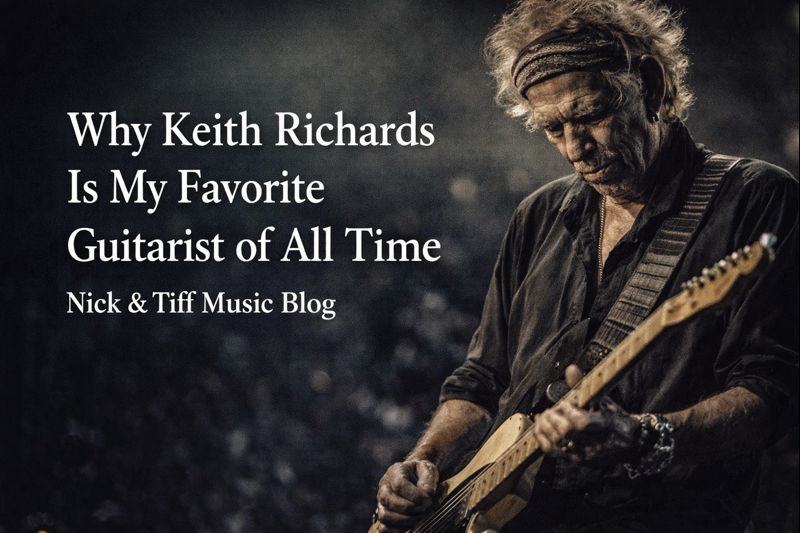
There are guitarists who impress you with speed, precision, and technical fireworks—and then there are guitarists who change the way you hear music. Keith Richards belongs firmly in the second category. He isn’t my favorite guitarist because he plays the most notes. He’s my favorite because he plays the right ones, at exactly the right moment, with a feel that’s impossible to fake.
Keith Richards doesn’t just play guitar—he defines what a guitar is supposed to do in a rock band.
It’s Always Been About the Song
Keith Richards has never chased guitar hero mythology. His playing has always served the song first, the band second, and his ego last. That mindset is rare. In an era where flash often overshadowed feel, Keith doubled down on groove, restraint, and attitude.
Listen to the opening seconds of almost any classic Rolling Stones track and you know immediately what band you’re hearing. That’s not coincidence—that’s identity. His riffs aren’t decorations; they are the song.
Where many guitarists build songs around solos, Keith builds songs around rhythm, space, and tension. The guitar doesn’t dominate—it drives.
You can explore more of our Rolling Stones coverage here.
Get weekly album deep dives, playlists, and local music news — delivered free.
The Power of the Riff
Keith Richards may be the greatest riff writer in rock history. His riffs don’t feel written—they feel discovered, like they were always floating around in the air and he just reached out and grabbed them.
What makes his riffs special isn’t complexity—it’s inevitability. Once you hear them, they feel permanent. They lock in with the drums, breathe with the groove, and leave just enough space for everything else to shine.
There’s a looseness to his playing that somehow never sounds sloppy. It swings. It struts. It moves. Keith understood early on that rock and roll isn’t about perfection—it’s about momentum.
Riffs That Became Rock Vocabulary
When people talk about the greatest riffs in rock history, they’re often talking about Keith Richards—whether they realize it or not. From the swagger of Satisfaction, to the hypnotic groove of Brown Sugar, to the raw, open-G punch of Start Me Up, his riffs don’t just introduce songs—they define them.
Support Nick & Tiff Music: As an affiliate these links help support the blog at no extra cost to you — and we truly appreciate it! Thank you for supporting.
Shop The Rolling Stones Music, Books & Merch
Rhythm Guitar as a Lead Instrument
Keith Richards redefined what rhythm guitar could be. He blurred the line between rhythm and lead so completely that the distinction often disappears. His parts weave around the vocal, dance with the drums, and occasionally step forward without ever announcing themselves.
That’s a big reason why the Rolling Stones always sounded like a band, not a collection of individuals competing for attention. Keith’s guitar parts leave room—for Mick Jagger’s vocals, for Charlie Watts’ swing, for the song to breathe.
It’s confidence without showmanship. Authority without arrogance.
Tone, Feel, and Fearlessness
Keith’s tone is instantly recognizable—not because it’s polished, but because it’s alive. Open tunings, stripped-down setups, battered guitars—everything about his approach strips away excess and gets straight to the soul of the sound.
There’s also a fearlessness to his playing. Keith is never afraid of leaving a little dirt on the notes, letting strings ring, or leaning into imperfections. Those imperfections are where the humanity lives. They remind you that rock and roll is supposed to feel dangerous, not rehearsed.
Popularizing (and Practically Inventing) Open G
One of the most overlooked reasons Keith Richards stands apart from nearly every other guitarist is his relationship with Open G tuning. While he didn’t technically invent the tuning, he made it famous—and more importantly, he made it essential to the Rolling Stones’ sound.
By stripping the guitar down to five strings and tuning to Open G, Keith unlocked a new rhythmic language. Chords became percussive. Riffs became looser, funkier, and more vocal-like. The guitar stopped behaving like a traditional lead instrument and started acting like a groove machine.
Open G allowed Keith to blur the line between rhythm and lead even further. He could hammer, slide, and stab chords in ways that felt raw and physical, almost like the guitar was part of the rhythm section rather than floating above it. That tuning wasn’t a gimmick—it was a philosophy. Less strings, less clutter, more feel.
Once you hear that sound, you can’t unhear it. It’s baked into the DNA of the Stones and into rock music as a whole. Countless guitarists have borrowed from it, but no one ever owned it the way Keith Richards did.
Shop Open-G Guitar Tuning Books
Longevity Without Compromise
Decades into his career, Keith Richards never reinvented himself to chase trends. He never needed to. His style wasn’t tied to a moment—it was tied to a feeling. While others evolved by changing sounds, Keith evolved by deepening his groove.
That consistency isn’t stagnation—it’s conviction. He trusted his instincts, trusted the music, and trusted that authenticity would always outlast fashion.
The Undeniable Cool Factor
It would be impossible to write about why Keith Richards is my favorite guitarist of all time without acknowledging the obvious—he might be the coolest person rock music ever produced.
But Keith’s cool isn’t about fashion, excess, or rebellion for its own sake. It’s about effortless confidence. He never looked like he was trying to impress anyone. He stood still when others flailed. He smiled when others chased attention. That calm, unbothered presence translated directly into his playing.
His guitar parts have that same energy. They don’t beg to be noticed—they dare you to ignore them. They swagger instead of sprint. They trust the groove instead of forcing it. That kind of cool can’t be manufactured or taught. It comes from knowing exactly who you are and never apologizing for it.
Keith didn’t just play rock and roll—he embodied it. And that authenticity is a huge part of why everything he touches sounds timeless.
Why He’ll Always Be My Favorite
Keith Richards is my favorite guitarist of all time because he represents everything I love about rock music: feel over flash, groove over ego, songs over solos. He proves that you don’t need to be the loudest or fastest to be unforgettable—you just need to be true.
His playing reminds me that the guitar’s greatest power isn’t technical mastery—it’s emotional honesty. And no one has ever delivered that honesty with more swagger, soul, and staying power than Keith Richards.
Some guitarists amaze you.
Keith Richards moves you.
Like, comment, or share — and let us know your take in the comments.
If this piece resonated with you, consider sharing it with a friend who might appreciate it too. That kind of word-of-mouth support really helps the blog grow, and we’re grateful for it.
Explore more by Artist.
Bands & Artists | Explore Music Coverage by Artist – Nick & Tiff Music Blog
More From Nick & Tiff Music Blog
What Is The Best Rolling Stones Album? Here’s What Each One Does Best
The 10 Most Underrated Rolling Stones Songs (In Chronological Order)
The Most Underrated Rolling Stones Songs – Part 2 (11–20) (In Chronological Order)
Some of Us by The Rolling Stones Meaning: Keith Richards’ Vulnerable Vocal
In The Stars by The Rolling Stones Meaning: Fate, Luck, and Stones Swagger
Rough and Twisted by The Rolling Stones Meaning: New Stones With A Classic Stones Sound
Beggars Banquet Album Review #33: The Rolling Stones Find Their Dark Roots (1968)
Let It Bleed Album Review #28: The Rolling Stones’ Dark and Dangerous Masterpiece
Sticky Fingers Album Review #23: The Rolling Stones at Their Absolute Peak
The Rolling Stones – Exile on Main St. (1972) | Album Review #11
Hackney Diamonds: Why the Rolling Stones’ Latest Album Is Their Most Underrated
Sympathy for the Devil Meaning: The Rolling Stones’ Song About Blame, Evil, and Human Responsibility
Gimme Shelter (1969) Meaning & Song Review – The Rolling Stones
Paint It Black (1966) – Meaning & Song Review – The Rolling Stones
Beast of Burden (1978) – Meaning & Song Review – The Rolling Stones
Moonlight Mile Lyrics Meaning: The Rolling Stones’ Most Reflective Song
Dead Flowers Meaning: The Dark Truth Behind The Rolling Stones Song
Tumblin’ Dice Lyrics Meaning: The Rolling Stones Song About Risk and Desire
What Is “Loving Cup” About? The Rolling Stones’ Warm and Soulful Gem
Shine A Light Lyrics Meaning: The Rolling Stones’ Gospel Tribute to Brian Jones
Shattered Lyrics Meaning: The Rolling Stones’ Take on NYC in the 70s
Jumpin’ Jack Flash Lyrics Meaning: The Rolling Stones Turn Struggle Into Swagger
Street Fighting Man by The Rolling Stones Meaning: Revolution, Frustration, and Rock and Roll
100 Years Ago Lyrics Meaning: The Rolling Stones Song About Growing Older
Jigsaw Puzzle Lyrics Meaning: The Rolling Stones’ Sharp, Surreal Portrait of Chaos
Monkey Man Lyrics Meaning: The Rolling Stones Mock Their Own Reputation
Same Vibes #9: Mick Jagger & Steven Tyler
Mike McCready Is the Most Underrated Guitarist of All Time
What Is the Best Beatles Album? A Look at Their Greatest Records
The 10 Most Underrated Beatles Songs (In Chronological Order)
Why Revolver Is The Beatles’ Most Underrated Masterpiece
Led Zeppelin IV vs. The Dark Side of the Moon
This article is part of our Weekly Music Discussion…
Weekly Music Discussion | Nick & Tiff Music Blog
If you liked this piece, you might enjoy our weekly album deep dives and playlists. You can subscribe below – it’s free.
You can find all of our Posts on our HOMEPAGE…
Nick & Tiff Music Blog – ALBUM REVIEWS – WEEKLY PLAYLISTS – GEAR TALK
Leave a Reply