
What Is “Sympathy for the Devil” About?
“Sympathy for the Devil” by The Rolling Stones is about evil, history, and the way people blame their worst actions on something outside themselves. The Rolling Stones use the Devil as the narrator, but the song is not really saying Satan caused every terrible thing in the world. It is asking why human beings keep using evil as an excuse instead of taking responsibility for what they do.
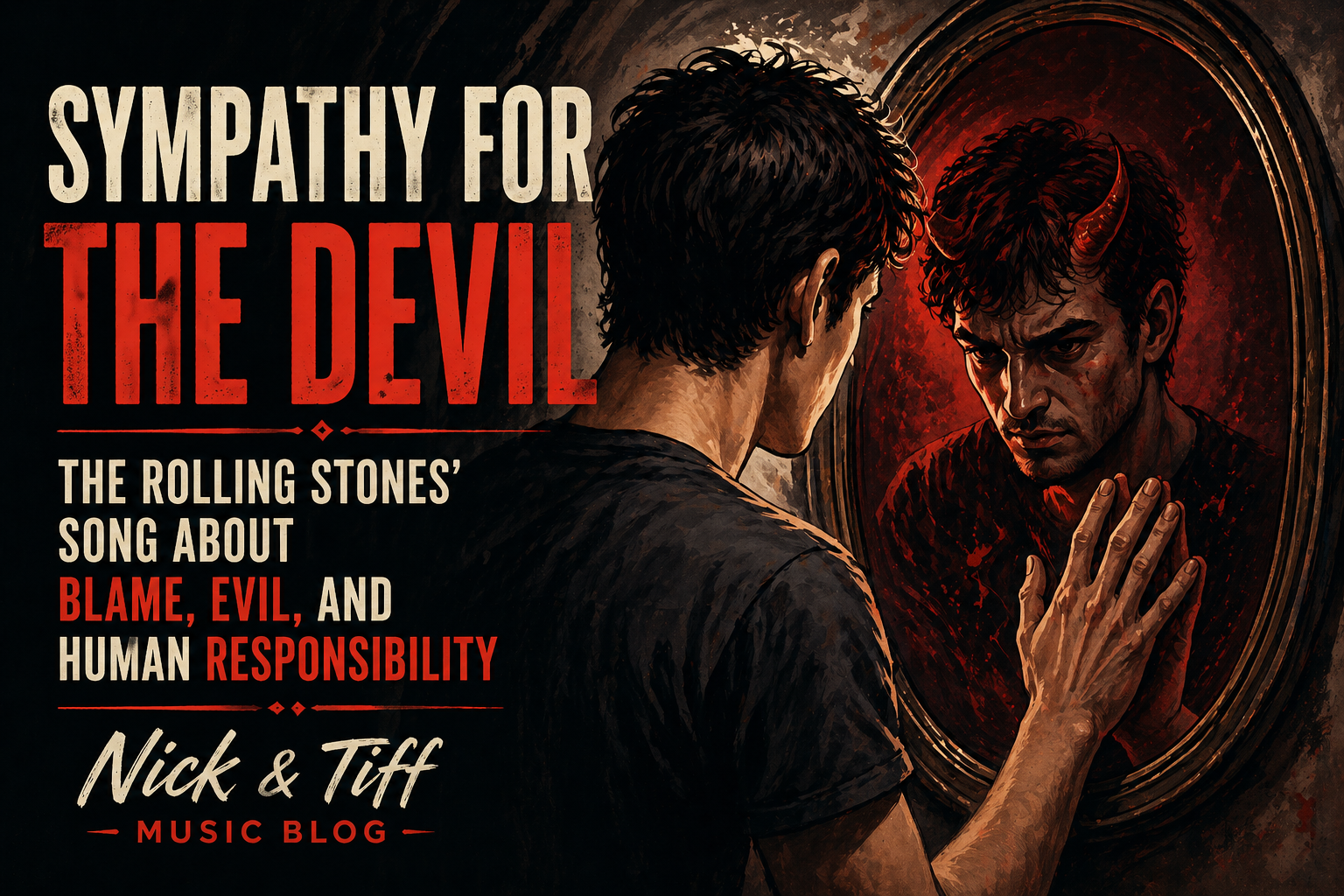
That is what makes the song so powerful. The Devil in “Sympathy for the Devil” is not just a villain. He is a mirror. He points to war, murder, greed, and cruelty, but the deeper message is that people made those choices. The Devil may be standing there in the song, but humanity is never innocent.
In that sense, “Sympathy for the Devil” feels like a warning: stop using the Devil as a crutch. Stop blaming darkness, temptation, or some outside force for human wrongdoing. The song forces the listener to look at evil in a more uncomfortable way — not as something far away from us, but as something people participate in, justify, and repeat.
For more deep dives like this visit our Rolling Stones page:
The Rolling Stones – Nick & Tiff Music Blog
Quick Details
Song: Sympathy for the Devil
Artist: The Rolling Stones
Album: Beggars Banquet
Released: 1968
Written by: Mick Jagger and Keith Richards
Genre: Rock / samba-influenced rock
Best Known For: Mick Jagger’s Devil narrator, the “woo-woo” backing vocals, and Keith Richards’ sharp guitar solo
The Devil as a Mirror, Not Just a Villain
The smartest part of “Sympathy for the Devil” is that the Devil sounds charming and polite. He does not arrive like a horror-movie monster. He introduces himself calmly, almost like a guest at a party.
That makes the song more unsettling. Evil does not always look obvious. Sometimes it comes through power, confidence, charisma, and excuses. Sometimes people do terrible things and then hide behind a story that makes them feel less responsible.
The Devil in the song works best as a symbol. He represents temptation and corruption, but he also represents the excuse people use after the damage is done. The song seems to push back against the idea that “the Devil made me do it.” Wars are started by people. Betrayals are carried out by people. Violence is justified by people.
Support Nick & Tiff Music: As an affiliate these links help support the blog at no extra cost to you-and we truly appreciate it! Thank you for supporting.
Buy Beggars Banquet Vinyl & CD on Amazon
Shop Rolling Stones Music, Books & Merch on Amazon
The Meaning of the Title
The title “Sympathy for the Devil” can be read less as a defense of evil and more as a critique of how often people blame it on something outside themselves.
Instead of the Devil being the cause of every bad decision, the song suggests he’s become the one people point to after the damage is done. In that sense, the title feels almost ironic — like the Devil deserves sympathy not because he’s innocent, but because he keeps getting credit for things human beings chose to do.
It’s a clever way of saying: look in the mirror and take responsibilities for your actions.
The Music: Why It Sounds So Hypnotic
Part of what makes “Sympathy for the Devil” so effective is that it does not sound like a typical dark rock song. The song began as more of a slow, Dylan-like folk idea before transforming in the studio into something much more rhythmic, hypnotic, and dangerous.
That transformation is a huge part of its identity. Instead of being built around a traditional rock riff, “Sympathy for the Devil” is driven by percussion, piano, bass, and that unforgettable “woo-woo” backing vocal. The Brazilian and Afro-Brazilian influence gives the song a loose, almost ritual-like energy, even if it still feels more like a Rolling Stones rock song than a traditional samba piece.
That contrast matters. The lyrics are about evil, violence, blame, and history, but the music pulls you in. It feels alive, seductive, and almost celebratory. That is exactly why the song works so well. Evil does not always appear as something ugly and obvious. Sometimes it has charm. Sometimes people join in before they realize what they are part of.
Keith Richards’ guitar solo adds a sharp burst of danger. It cuts through the groove with a biting tone, giving the song one of its most memorable rock moments without breaking the spell.
Why “Sympathy for the Devil” Was Controversial
“Sympathy for the Devil” became controversial because of its title, its narrator, and the Rolling Stones’ image. Some listeners heard the song as a celebration of Satanic imagery, but that misses the deeper point.
The song is not simple shock value. It is a moral provocation. It uses the Devil’s voice to force listeners to look at war, murder, power, and hypocrisy without the comfort of an easy explanation, or to show how people use the Devil as the easy explanation.
The controversy almost proves the song’s point. It is easier to be shocked by the Devil than to ask why human beings keep repeating the same patterns of violence and blame.
Where It Fits on Beggars Banquet
As the opening track on Beggars Banquet, “Sympathy for the Devil” immediately announces a darker, sharper Rolling Stones. The album moves away from some of the psychedelic colors of the previous year and leans into blues, folk, country, and roots-based rock with a more dangerous edge.
“Sympathy for the Devil” sets the tone perfectly. It is intelligent, theatrical, unsettling, and impossible to ignore. It takes an old idea — the Devil as tempter, witness, and scapegoat — and turns it into something modern: a song about history, power, blame, and responsibility.
Explore the Beggars Banquet album further with our deep dive on “Jigsaw Puzzle.”
Jigsaw Puzzle Lyrics Meaning: The Rolling Stones’ Sharp, Surreal Portrait of Chaos
Final Thoughts
“Sympathy for the Devil” works first because it’s a great song. The groove pulls you in, the vocal is unforgettable, and it never really sounds like anything else.
But what makes it stick is the idea underneath it. The song doesn’t just point at evil — it challenges the way people explain it.
Thanks for reading and supporting Nick & Tiff Music Blog, it really means a lot to us.
If you enjoyed this piece, you might enjoy our weekly music discussions, song meaning breakdowns, and full track-by-track album deep dives. You can subscribe below – it’s free.
FAQ About “Sympathy for the Devil”
What is “Sympathy for the Devil” by The Rolling Stones about?
“Sympathy for the Devil” is about evil, history, and human responsibility. The song uses the Devil as narrator, but its deeper meaning is about how people blame evil on an outside force instead of facing their own choices.
Is “Sympathy for the Devil” Satanic?
No, “Sympathy for the Devil” is not a satanic song. It uses the Devil as a narrator to show how people shift blame for human actions instead of taking responsibility.
Why is “Sympathy for the Devil” controversial?
It was controversial because of its title, its Devil narrator, and The Rolling Stones’ image. But the song is more layered than simple shock value. It uses the Devil to challenge listeners to think about evil and responsibility.
What album is “Sympathy for the Devil” on?
“Sympathy for the Devil” is the opening track on The Rolling Stones’ 1968 album Beggars Banquet.
Explore more by Artist.
Bands & Artists | Explore Music Coverage by Artist – Nick & Tiff Music Blog
More From Nick & Tiff Music Blog
What Is The Best Rolling Stones Album? Here’s What Each One Does Best
The 10 Most Underrated Rolling Stones Songs (In Chronological Order)
The Most Underrated Rolling Stones Songs – Part 2 (11–20) (In Chronological Order)
In The Stars by The Rolling Stones Meaning: Fate, Luck, and Stones Swagger
Rough and Twisted by The Rolling Stones Meaning: New Stones With A Classic Stones Sound
Beggars Banquet Album Review #33: The Rolling Stones Find Their Dark Roots (1968)
Let It Bleed Album Review #28: The Rolling Stones’ Dark and Dangerous Masterpiece
Sticky Fingers Album Review #23: The Rolling Stones at Their Absolute Peak
The Rolling Stones – Exile on Main St. (1972) | Album Review #11
Hackney Diamonds: Why the Rolling Stones’ Latest Album Is Their Most Underrated
Salt of the Earth by The Rolling Stones Meaning: A Toast to the Working Class
Dancing with Mr. D Lyrics Meaning: The Rolling Stones Facing the Darkness Around Them
Honky Tonk Women by The Rolling Stones: The Story Behind the Swagger
Tumblin’ Dice Lyrics Meaning: The Rolling Stones Song About Risk and Desire
What Is “Loving Cup” About? The Rolling Stones’ Warm and Soulful Gem
Shine A Light Lyrics Meaning: The Rolling Stones’ Gospel Tribute to Brian Jones
Monkey Man Lyrics Meaning: The Rolling Stones Mock Their Own Reputation
Moonlight Mile Lyrics Meaning: The Rolling Stones’ Most Reflective Song
Jigsaw Puzzle Lyrics Meaning: The Rolling Stones’ Sharp, Surreal Portrait of Chaos
Shattered Lyrics Meaning: The Rolling Stones’ Take on NYC in the 70s
Jumpin’ Jack Flash Lyrics Meaning: The Rolling Stones Turn Struggle Into Swagger
Paint It Black (1966) – Meaning & Song Review – The Rolling Stones
Gimme Shelter (1969) Meaning & Song Review – The Rolling Stones
Beast of Burden (1978) – Meaning & Song Review – The Rolling Stones
No Expectations Meaning & Song Review: The Rolling Stones at Their Most Vulnerable
Doo Doo Doo Doo Doo (Heartbreaker) Meaning: The Rolling Stones’ Dark Song About Violence and Power
100 Years Ago Lyrics Meaning: The Rolling Stones Song About Growing Older
Why Keith Richards Is My Favorite Guitarist of All Time
One of the Most Underrated Rolling Stones Songs: Saint of Me (1997)
Same Vibes #9: Mick Jagger & Steven Tyler
What Is the Best Beatles Album? A Look at Their Greatest Records
What Is the Best Bob Dylan Album? A Look at the Legendary Songwriter’s Greatest Records
What Is the Best Bruce Springsteen Album? A Look at His Greatest Records
What Is the Best Neil Young Album? A Look at His Greatest Records
What Is the Best Led Zeppelin Album? Exploring the Band’s Greatest Records
What Is The Best Tom Petty Album? Exploring His Greatest Records
The 10 Most Underrated Beatles Songs (In Chronological Order)
The Beatles – The White Album (1968) | Album Review #9
Check out our Song Review Archives page
Song Reviews | Nick & Tiff Music Blog
Explore more on the Homepage:
Nick & Tiff Music Blog – ALBUM & SONG REVIEWS – GEAR TALK & STORE UPDATES
Leave a Reply