
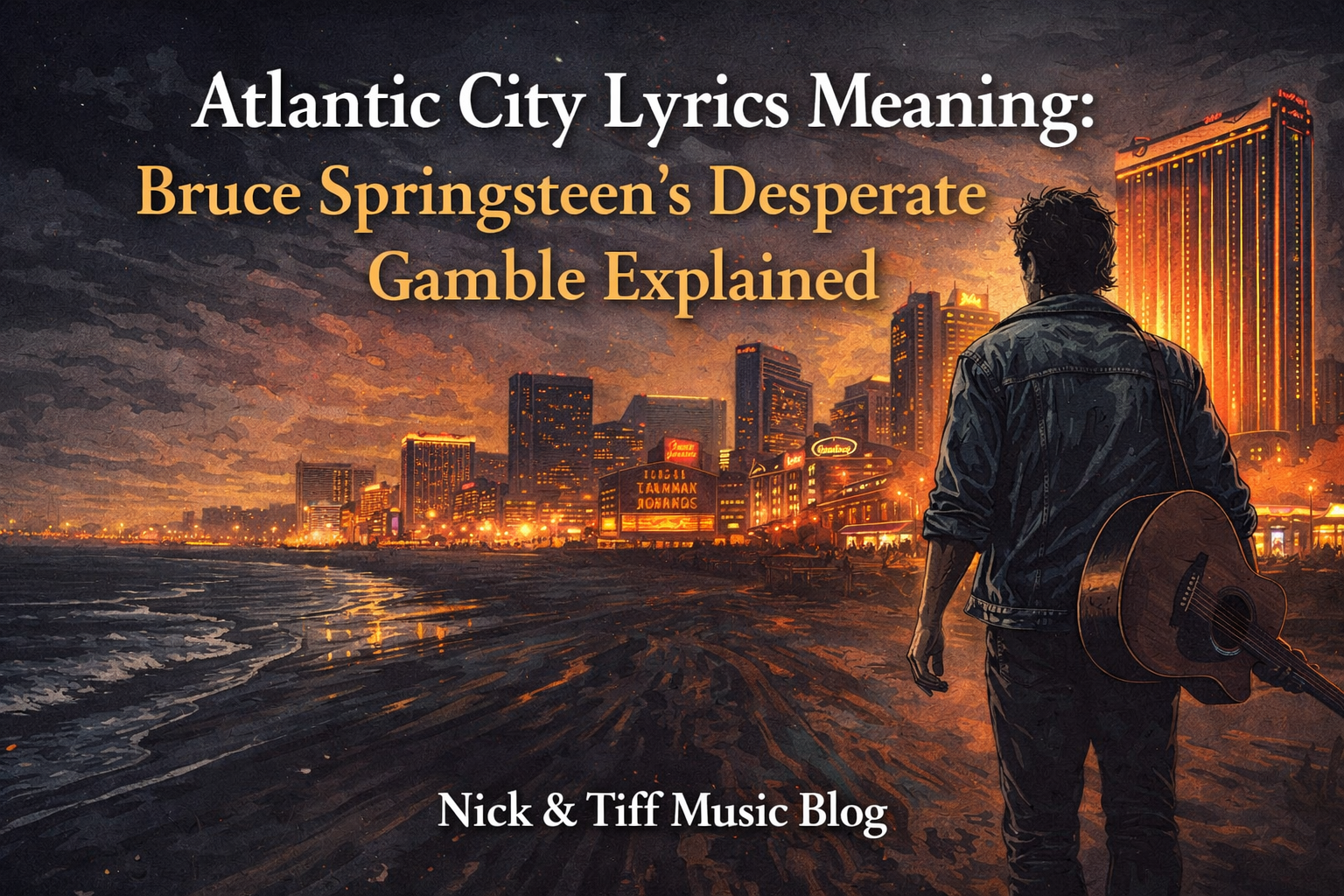
Few songs capture the bleak reality of economic desperation quite like “Atlantic City.” Released in 1982 on Bruce Springsteen’s haunting acoustic album Nebraska, the song tells the story of a man pushed to the edge by financial ruin and bad decisions.
Built around a simple acoustic guitar and a stark narrative, “Atlantic City” follows a narrator who believes the only way forward is through crime — even if it destroys him. With unforgettable lines like “Everything dies, baby, that’s a fact / But maybe everything that dies someday comes back,” Springsteen creates a story that feels both hopeless and strangely determined.
Let’s take a closer look at the meaning of “Atlantic City” and why this song remains one of Bruce Springsteen’s most powerful narratives.
Quick Details
Song: Atlantic City
Artist: Bruce Springsteen
Album: Nebraska
Released: 1982
Written by: Bruce Springsteen
Length: 3:56
Explore more of our Bruce Springsteen discussions, song meanings, & album reviews here.
What Is “Atlantic City” by Bruce Springsteen About?
The meaning of “Atlantic City” by Bruce Springsteen is about desperation and the risks people take when they feel they have no other options.
The song follows a narrator whose life has fallen apart financially and emotionally. Hoping for a fresh start, he heads to Atlantic City — a place associated with gambling, organized crime, and dangerous opportunities.
Springsteen uses the story to explore how survival can push people toward choices they might otherwise avoid.
In the early 1980s, Atlantic City was transforming into a gambling hub filled with casinos and organized crime influence — making it the perfect setting for the narrator’s desperate gamble.
The city represents both hope and danger. It’s a place where fortunes can change overnight, but also where people often lose everything.
Springsteen’s narrator believes Atlantic City might offer one last chance to rebuild his life, but the path he chooses likely involves violence or illegal work tied to the mob.
In other words, the song explores a powerful question:
What happens when survival becomes more important than morality?
The Story Behind the Song
“Atlantic City” appears on Springsteen’s 1982 album Nebraska, one of the most unusual and influential records of his career.
The album began as a set of home demo recordings that Springsteen captured on a simple 4-track cassette recorder in his New Jersey bedroom. These stripped-down recordings featured little more than acoustic guitar, harmonica, and Springsteen’s voice.
Springsteen later brought the songs to the E Street Band and attempted to record full-band versions, including “Atlantic City.” However, the fuller arrangements never captured the stark, haunting mood of the original demos.
In the end, Springsteen decided to release the raw cassette recordings themselves, giving Nebraska its quiet, unsettling atmosphere.
The result was a record filled with dark storytelling about crime, desperation, isolation, and moral conflict — and “Atlantic City” became one of its most memorable songs.
You can explore the meaning of the title track from Nebraska here:
Nebraska Lyrics Meaning: Bruce Springsteen’s Darkest Song Explained
Atlantic City Lyrics Meaning: Line-by-Line Themes
“Well they blew up the Chicken Man in Philly last night…”
The opening line immediately sets the tone.
Springsteen references the real-life mob assassination of Philadelphia crime boss Philip “Chicken Man” Testa in 1981, grounding the story in the world of organized crime.
By beginning with a news-like detail, Springsteen places the listener directly into a gritty, dangerous reality.
“Now our luck may have died and our love may be cold…”
Early in the song, the narrator describes a life that seems to be falling apart.
His relationship is strained, and his financial situation appears hopeless.
Yet he still clings to the idea that things might turn around.
“Everything dies, baby, that’s a fact…”
This is easily the song’s most famous lyric.
The line reflects a brutally honest worldview — everything eventually fades or collapses.
But the second half of the lyric introduces a small spark of hope:
“Maybe everything that dies someday comes back.”
The narrator is trying to convince himself that even after failure or ruin, there might still be another chance.
“Put your makeup on, fix your hair up pretty…”
In this moment, the narrator speaks to his partner.
He’s asking her to come with him to Atlantic City — essentially inviting her into his risky plan.
There’s tenderness in the request, but also a sense that the decision has already been made.
“Everything that dies someday comes back…”
By the end of the song, this idea becomes almost like a mantra.
The narrator repeats it as though he needs to believe it.
Whether it’s hope or self-deception is left unclear — and that ambiguity is part of what makes the song so powerful.
The Sound of the Song
Musically, “Atlantic City” is strikingly minimal.
The original Nebraska version features little more than acoustic guitar and Springsteen’s voice, creating a quiet, almost ghostly atmosphere.
This stripped-down approach reinforces the storytelling. Without a full band arrangement, the listener focuses entirely on the narrative and emotion.
It also mirrors the themes of the song — loneliness, isolation, and desperation.
Interestingly, later live performances with the E Street Band transformed the song into something bigger and more dramatic, but the original recording remains one of the most haunting moments in Springsteen’s catalog.
Support Nick & Tiff Music: As an affiliate these links help support the blog at no extra cost to you – and we truly appreciate it! Thank you for supporting.
Shop Bruce Springsteen Vinyls, CDs, Books & Merch
See Bruce Springsteen Live:
See Bruce Springsteen Tour Dates & Tickets
Why “Atlantic City” Still Resonates
“Atlantic City” remains one of Bruce Springsteen’s most powerful songs because it captures a feeling that many people understand: the fear of running out of options.
The narrator isn’t a villain or a hero. He’s simply someone trying to survive in a world that seems stacked against him.
Springsteen doesn’t glorify crime or desperation — he simply tells the story with honesty and empathy.
And that honesty is what makes the song so unforgettable.
“Atlantic City” Frequently Asked Questions
Who was the “Chicken Man” mentioned in “Atlantic City”?
The opening line of “Atlantic City” references the real-life assassination of Philadelphia mob boss Philip “Chicken Man” Testa in 1981. Springsteen used this event to immediately place the song in a world connected to organized crime and violence.
Why is Atlantic City important in the song?
In the early 1980s, Atlantic City was becoming a major gambling destination after casinos were legalized. In the song, the city symbolizes both hope and danger—a place where someone desperate might gamble everything on one last chance to change their life.
Was “Atlantic City” recorded with the E Street Band?
Bruce Springsteen did record attempts at “Atlantic City” with the E Street Band, but the fuller arrangements didn’t capture the haunting mood of the original home demo. In the end, Springsteen chose to release the raw 4-track cassette recordings that became the album Nebraska.
What album is “Atlantic City” by Bruce Springsteen on?
“Atlantic City” appears on Bruce Springsteen’s 1982 album Nebraska, a stark acoustic record known for its haunting storytelling and minimalist production.
Final Thoughts
More than four decades after its release, “Atlantic City” remains one of Bruce Springsteen’s most haunting songs and one of the most powerful storytelling tracks on Nebraska.
With just an acoustic guitar and a stark narrative, Springsteen paints a portrait of a man standing at the edge of desperation — hoping that one risky decision might change everything.
Whether that hope is justified is left unanswered.
But the emotional truth of the song remains undeniable.
Like, comment, or share — and let us know your take in the comments, or if you’re a subscriber and would rather reply directly, just hit reply to the email. I read every message.
If this piece resonated with you, consider sharing it with a friend who might appreciate it too. That kind of word-of-mouth support really helps the blog grow, and we’re grateful for it.
Browse our posts by Bands & Artists:
Bands & Artists | Explore Music Coverage by Artist – Nick & Tiff Music Blog
Related Reads
What Is the Best Bruce Springsteen Album? A Look at His Greatest Records
Nebraska Lyrics Meaning: Bruce Springsteen’s Darkest Song Explained
Bruce Springsteen – Born to Run (1975) Album Review #4
Thunder Road (1975) – Meaning & Song Review – Bruce Springsteen
Backstreets (1975) Meaning & Song Review – Bruce Springsteen
Glory Days Lyrics Meaning: Bruce Springsteen’s Nostalgic Look at the Past
Dancing in the Dark Lyrics Meaning: Bruce Springsteen’s Breakthrough Anthem Explained
No Surrender Lyrics Meaning: Bruce Springsteen’s Anthem About Never Giving Up
Lonesome Day Lyrics Meaning: Bruce Springsteen’s Song of Resilience Explained
Same Vibes #3: Nebraska & Blood on the Tracks
From Dylan to Springsteen to Zach Bryan: The Lineage of the American Songwriter
What Is the Best Beatles Album? A Look at Their Greatest Records
What Is the Best Led Zeppelin Album? Exploring the Band’s Greatest Records
What Is the Best Bob Dylan Album? A Look at the Legendary Songwriter’s Greatest Records
Tangled Up in Blue (1975) Meaning & Song Review – Bob Dylan
The Freewheelin’ Bob Dylan (1963) – Bob Dylan | Album Review #12
Zach Bryan – With Heaven on Top (2026) | Album Review #6
Pink Skies (2024) – Meaning & Song Review – Zach Bryan
Sun to Me (2022) – Meaning & Song Review –Zach Bryan
New Orleans Is Sinking (1989) Meaning & Song Review – The Tragically Hip
Artist Spotlight #10: Donovan Woods
Check out our Song Review Archives:
Song Reviews | Nick & Tiff Music Blog
If you liked this piece, you might enjoy our weekly album deep dives and playlists. You can subscribe below – it’s free.
Here’s a link to our Homepage where you can find all of our posts:
Nick & Tiff Music Blog – ALBUM REVIEWS – WEEKLY PLAYLISTS – GEAR TALK
Leave a Reply