
Quick Details
Song: Nebraska
Artist: Bruce Springsteen
Album: Nebraska
Released: 1982
Written by: Bruce Springsteen
Length: 4:30
Genre: Folk / Acoustic Rock
What Is “Nebraska” by Bruce Springsteen About?
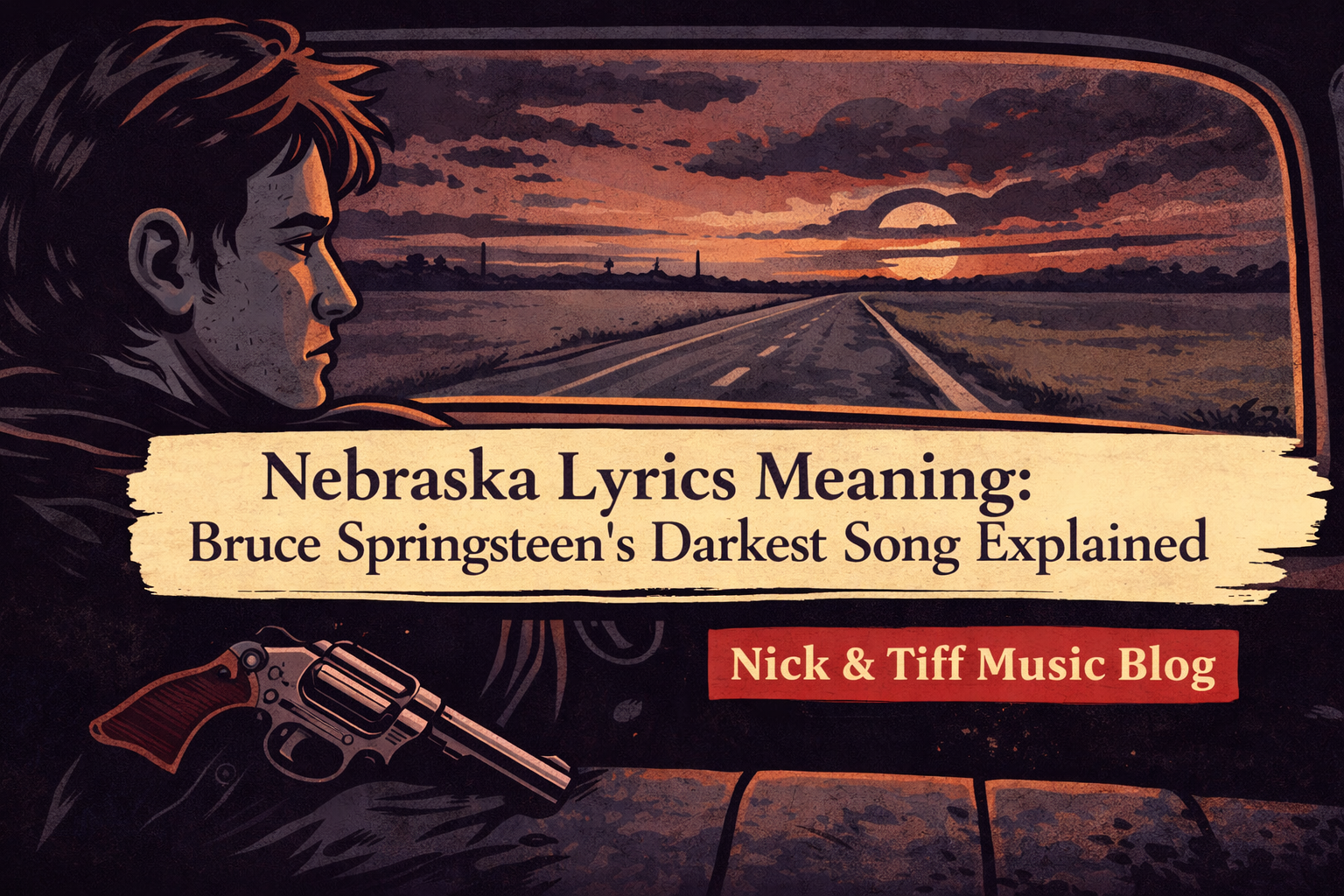
The meaning of “Nebraska” by Bruce Springsteen centers on the chilling perspective of a remorseless killer reflecting on his crimes and fate. The song, from Springsteen’s stark 1982 album Nebraska, was inspired by the real-life murder spree of Charles Starkweather. The song explores themes of alienation, moral emptiness, and the darker corners of the American psyche.
Unlike many of Springsteen’s songs that celebrate working-class dreams and resilience, “Nebraska” strips everything down to something far bleaker. The narrator speaks calmly and matter-of-factly about violence and death, revealing a disturbing lack of remorse.
By presenting the story from the killer’s perspective, Springsteen forces listeners to confront uncomfortable questions about human nature, guilt, and the idea of evil itself.
Explore more of our Bruce Springsteen discussions, song meanings, & album reviews here.
The Real Story Behind “Nebraska”
“Nebraska” was inspired by the crimes of Charles Starkweather, a teenage murderer who went on a killing spree across Nebraska and Wyoming in 1957 with his girlfriend Caril Ann Fugate.
Starkweather murdered eleven people before being captured and eventually executed in the electric chair in 1959.
Springsteen was reportedly influenced by the 1973 film Badlands, which dramatized the Starkweather murders. The movie’s detached storytelling style echoes strongly in the song, where the narrator calmly recounts horrific acts without emotional reaction.
This unsettling perspective is exactly what gives “Nebraska” its power.
A Killer’s Voice
One of the most haunting elements of “Nebraska” is how ordinary the narrator sounds.
Rather than portraying a dramatic or cartoonish villain, the voice in the song speaks quietly and plainly:
“I guess there’s just a meanness in this world.”
That single line sums up the song’s bleak worldview.
The narrator doesn’t try to justify his actions in a traditional sense. Instead, he suggests that violence is simply part of the world’s nature — something inevitable rather than shocking.
This perspective is chilling because it removes the moral framework we expect from stories about crime.
The Stark Simplicity of the Recording
The sound of “Nebraska” is just as important as the story it tells.
The song appears on Springsteen’s 1982 album Nebraska, which was originally recorded as a set of rough acoustic demos on a 4-track cassette recorder in Springsteen’s bedroom.
At first, Springsteen actually planned to re-record the songs with the E Street Band in a full studio setting. The band attempted versions of the material, but something about the polished arrangements didn’t feel right.
The original demos carried a haunting intimacy that was impossible to recreate.
Rather than polish the songs into something bigger, Springsteen made the unusual decision to release those stark demo recordings as the finished album. The result was one of the most stripped-down and atmospheric records of his career.
On “Nebraska,” the quiet acoustic guitar and distant harmonica create an eerie sense of isolation. The minimal production makes the narrator’s calm voice feel even more unsettling — as if the story is being told alone in the middle of the night.
A Dark Reflection of America
“Nebraska” stands apart in Springsteen’s catalog.
While many of his songs explore the struggles of ordinary Americans trying to build a better life, this song shows what happens when those dreams collapse entirely.
The narrator drifts through the American landscape — highways, small towns, empty roads — leaving death behind him.
In this way, the song becomes more than just a crime story. It’s a haunting meditation on alienation and the darker side of the American experience.
Like many of the great American storytellers — from Bruce Springsteen to Bob Dylan — the song uses narrative songwriting to explore darker corners of American life. You can also explore how Bob Dylan’s songwriting tackles similarly dark themes:
A Hard Rain’s A-Gonna Fall – Bob Dylan (1963) Meaning & Song Review
Ballad of a Thin Man (1965) Meaning & Song Review – Bob Dylan
Support Nick & Tiff Music: As an affiliate these links help support the blog at no extra cost to you – and we truly appreciate it! Thank you for supporting.
Shop Bruce Springsteen Vinyls, CDs, Books & Merch
See Bruce Springsteen Live:
See Bruce Springsteen Tour Dates & Tickets on Ticketmaster
Why “Nebraska” Still Feels So Powerful
More than forty years later, “Nebraska” remains one of Springsteen’s most disturbing and unforgettable songs.
Its power comes from its restraint. There are no dramatic climaxes or emotional outbursts — just a quiet voice describing terrible things.
That calm delivery makes the story even more unsettling.
Instead of telling listeners how to feel, Springsteen lets the emptiness of the narrator speak for itself.
Final Thoughts
“Nebraska” is one of the most haunting songs ever written by Bruce Springsteen.
With just an acoustic guitar and a few stark lyrics, Springsteen creates a chilling portrait of violence, alienation, and moral emptiness. The song’s quiet storytelling style makes it feel almost documentary-like, placing listeners uncomfortably close to the mind of its narrator.
More than a true-crime tale, “Nebraska” is a stark reminder that darkness can exist beneath the surface of everyday life — sometimes in the most ordinary voices.
Thanks for reading and supporting Nick & Tiff Music Blog, it really means a lot to us.
If you enjoyed this piece, you might enjoy our weekly music discussions, song meaning breakdowns, and full track-by-track album deep dives. You can subscribe below – it’s free.
Browse our posts by Bands & Artists:
Bands & Artists | Explore Music Coverage by Artist – Nick & Tiff Music Blog
More From Nick & Tiff Music Blog
What Is the Best Bruce Springsteen Album? A Look at His Greatest Records
Atlantic City Lyrics Meaning: Bruce Springsteen’s Desperate Gamble Explained
Bruce Springsteen – Born to Run (1975) Album Review #4
Thunder Road (1975) – Meaning & Song Review – Bruce Springsteen
Backstreets (1975) Meaning & Song Review – Bruce Springsteen
Born in the U.S.A. by Bruce Springsteen Meaning: The Misunderstood American Anthem
Glory Days Lyrics Meaning: Bruce Springsteen’s Nostalgic Look at the Past
Dancing in the Dark Lyrics Meaning: Bruce Springsteen’s Breakthrough Anthem Explained
No Surrender Lyrics Meaning: Bruce Springsteen’s Anthem About Never Giving Up
Lonesome Day Lyrics Meaning: Bruce Springsteen’s Song of Resilience Explained
Same Vibes #3: Nebraska & Blood on the Tracks
From Dylan to Springsteen to Zach Bryan: The Lineage of the American Songwriter
What Is the Best Beatles Album? A Look at Their Greatest Records
What Is the Best Bob Dylan Album? A Look at the Legendary Songwriter’s Greatest Records
What Is the Best Led Zeppelin Album? Exploring the Band’s Greatest Records
Tangled Up in Blue (1975) Meaning & Song Review – Bob Dylan
The Freewheelin’ Bob Dylan (1963) – Bob Dylan | Album Review #12
Zach Bryan – With Heaven on Top (2026) | Album Review #6
Pink Skies (2024) – Meaning & Song Review – Zach Bryan
Sun to Me (2022) – Meaning & Song Review –Zach Bryan
New Orleans Is Sinking (1989) Meaning & Song Review – The Tragically Hip
Artist Spotlight #10: Donovan Woods
Check out our Song Review Archives:
Song Reviews | Nick & Tiff Music Blog
Explore more on the Homepage:
Nick & Tiff Music Blog – ALBUM & SONG REVIEWS – GEAR TALK & STORE UPDATES
Leave a Reply