
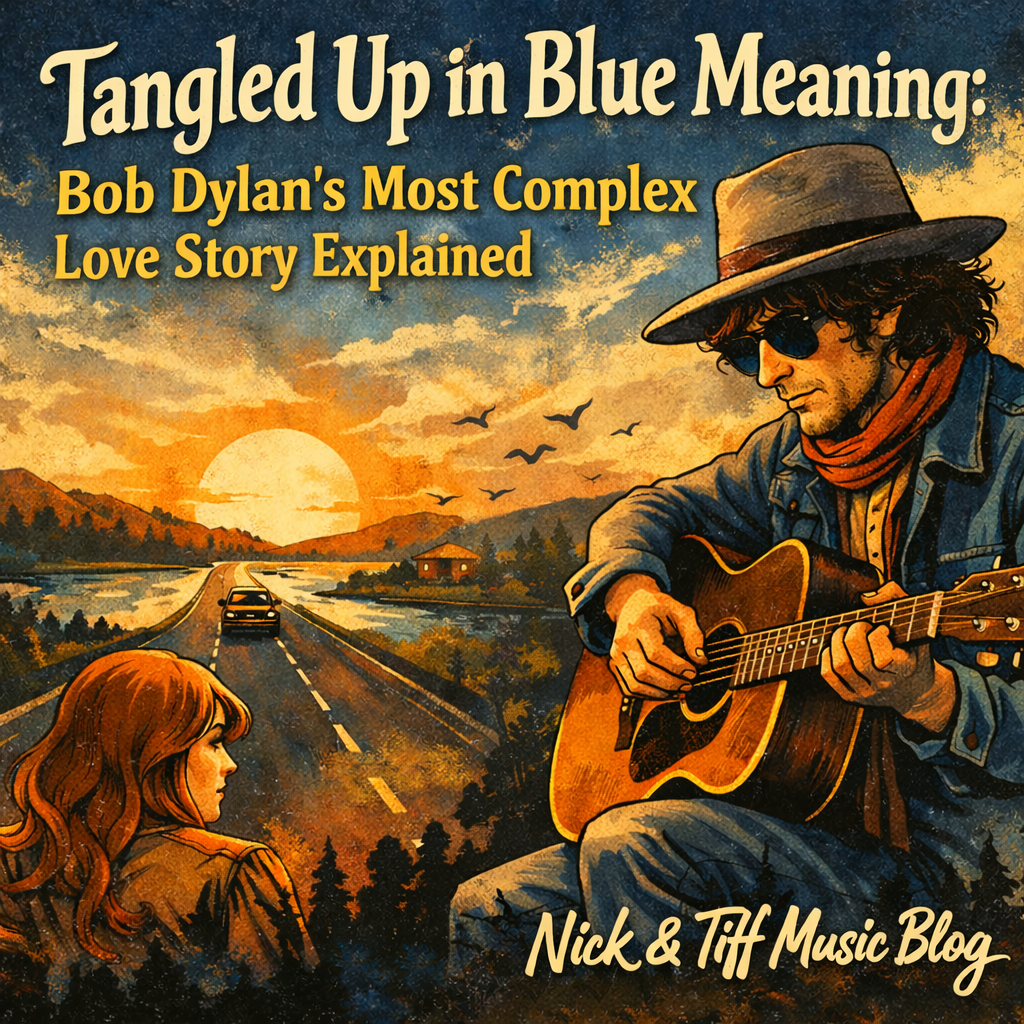
Few songs capture the feeling of memory — how it bends, shifts, and rewrites itself — like “Tangled Up in Blue.” Released in 1975 as the opening track on Blood on the Tracks, the song stands as one of the most celebrated works in the catalog of Bob Dylan.
It isn’t just a breakup song.
It’s a moving portrait of love seen from multiple angles at once.
Explore more Bob Dylan discussions, song meaning breakdowns & album reviews here.
Quick Details
- Artist: Bob Dylan
- Song: Tangled Up in Blue
- Album: Blood on the Tracks (1975)
- Writer: Bob Dylan
- Producer: Bob Dylan (credited as “David Zimmerman”)
- Genre: Folk Rock
- Length: 5:43
What Does “Tangled Up in Blue” by Bob Dylan Mean?
“Tangled Up in Blue” by Bob Dylan is about how love reshapes identity over time and how memory refuses to unfold in a straight line. The song follows two people whose lives intersect, separate, and reconnect across years — told through shifting perspectives and fractured timelines.
The “blue” in the title suggests sadness, but it also represents depth — longing, nostalgia, emotional complexity. The narrator isn’t simply heartbroken; he’s reflecting on how this relationship became woven into who he is.
One of the most revealing lines comes late in the song:
“We always did feel the same / We just saw it from a different point of view.”
The relationship didn’t fail because love disappeared. It fractured because perspective changed. Two people can feel deeply connected yet move in opposite directions.
At its core, the song suggests something quietly devastating:
Even when relationships end, they remain part of us.
We move forward — still tangled.
Lyrical Overview: A Story That Refuses to Sit Still
From the opening line — “Early one mornin’ the sun was shinin’…” — the song feels like a straightforward recollection. But as each verse unfolds, the narrative shifts.
The narrator is leaving in one verse. In another, he’s being left. Sometimes he watches from a distance. Other times he seems to step outside the story entirely.
Time folds in on itself.
Scenes appear out of order.
Details contradict each other.
Dylan once spoke about being influenced by Cubist art — presenting multiple perspectives at once rather than a single fixed viewpoint. “Tangled Up in Blue” feels like exactly that: emotional Cubism in song form.
Instead of a neat beginning-middle-end structure, we get snapshots — fragments of connection, separation, reflection.
It feels human because it feels imperfect.
Support Nick & Tiff Music: As an affiliate these links help support the blog at no extra cost to you — and we truly appreciate it! Thank you for supporting.
Shop Bob Dylan Vinyl, CDs, Books & Merch
Buy Blood on the Tracks Vinyl & CD
Try and catch Dylan on Tour:
See Bob Dylan Tour Dates & Tickets on Ticketmaster
Musically: Constant Motion, No Resolution
Musically, the song mirrors its theme of movement.
The steady acoustic guitar and driving rhythm create the feeling of forward momentum — almost like someone walking down a long highway with no clear destination. There’s no dramatic chorus explosion, no cinematic breakdown.
It moves.
It circles.
It continues.
That subtle repetition reinforces the idea that the emotional story isn’t finished. There’s no tidy closure — just life unfolding.
The arrangement is restrained, allowing the storytelling to carry the weight. And that restraint makes the emotion land even harder.
A Song That Evolves
One of the most fascinating aspects of “Tangled Up in Blue” is that Dylan has frequently rewritten it in live performances. During the Rolling Thunder era and beyond, he altered verses, shifted pronouns, and even changed perspectives entirely.
In some versions, the narrator speaks in first person.
In others, third person.
Sometimes entire scenes are rearranged.
It’s as if the story itself refuses to stay fixed.
Which feels fitting.
Because memory doesn’t stay fixed either.
Final Thoughts
“Tangled Up in Blue” remains one of Bob Dylan’s greatest achievements not because it tells a clear story — but because it tells a true one.
Love rarely ends in clean lines.
Memory rarely unfolds in order.
And identity is often shaped by the relationships we can’t fully leave behind.
Nearly fifty years later, the song still resonates because it captures something timeless:
We move on.
But parts of us remain tangled.
Like, comment, or share — and let me know your take in the comments.
If you enjoyed this piece, you might enjoy our weekly music discussions, song meaning breakdowns, and full track-by-track album deep dives. You can subscribe below – it’s free.
Browse our articles by Bands & Artists:
Bands & Artists | Explore Music Coverage by Artist – Nick & Tiff Music Blog
Related Reads
What Is the Best Bob Dylan Album? A Look at the Legendary Songwriter’s Greatest Records
Highway 61 Revisited Album Review #32: Bob Dylan Changes Rock Music Forever
Simple Twist of Fate Meaning & Song Review — Bob Dylan (1975)
Shelter from the Storm Lyrics Meaning: Bob Dylan’s Search for Redemption
The Freewheelin’ Bob Dylan (1963) – Bob Dylan | Album Review #12
Don’t Think Twice, It’s All Right Meaning: Not “Alright”—But Acceptance of What Was Meant to Be
A Hard Rain’s A-Gonna Fall – Bob Dylan (1963) Meaning & Song Review
Ballad of a Thin Man (1965) Meaning & Song Review – Bob Dylan
Tombstone Blues Lyrics Meaning: Bob Dylan’s Surreal Satire Explained
Desolation Row Lyrics Meaning: Bob Dylan’s Surreal Masterpiece Explained
Pledging My Time Lyrics Meaning: Bob Dylan’s Devotion Turns Obsessive
From Dylan to Springsteen to Zach Bryan: The Lineage of the American Songwriter
Same Vibes #3: Nebraska & Blood on the Tracks
What Is the Best Beatles Album? A Look at Their Greatest Records
What Is the Best Bruce Springsteen Album? A Look at His Greatest Records
What Is the Best Neil Young Album? A Look at His Greatest Records
What Is The Best Tom Petty Album? Exploring His Greatest Records
What Is the Best Led Zeppelin Album? Exploring the Band’s Greatest Records
Bruce Springsteen – Born to Run (1975) Album Review #4
The 10 Most Underrated Rolling Stones Songs (In Chronological Order)
The 10 Most Underrated Beatles Songs (In Chronological Order)
Why Revolver Is The Beatles’ Most Underrated Masterpiece
The Beatles – The White Album (1968) | Album Review #9
Check out our Song Review Archives page:
Song Reviews | Nick & Tiff Music Blog
Explore more on the Homepage:
Nick & Tiff Music Blog – ALBUM & SONG REVIEWS – GEAR TALK & STORE UPDATES
Leave a Reply