
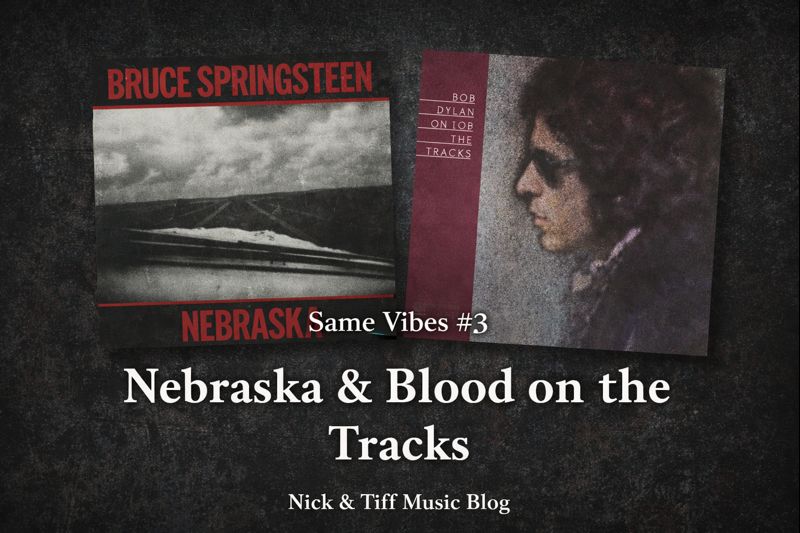
Some albums feel like they were written for an audience.
Others feel like they were written because the artist didn’t know how not to write them.
Bruce Springsteen’s Nebraska and Bob Dylan’s Blood on the Tracks live firmly in that second category.
These aren’t albums chasing a sound, a moment, or a chart position. They’re records that exist because something inside their creators needed to come out — quietly, honestly, and without protection.
You can also explore more Bruce Springsteen coverage here.
And more of our Bob Dylan coverage here.
Get weekly album deep dives, playlists, and local music news — delivered free.
Stripped Down to the Truth
Neither album hides behind production.
Nebraska is famously bare, recorded on a four-track cassette, its lo-fi sound amplifying the loneliness and desperation in its stories. Blood on the Tracks isn’t lo-fi in the same way, but it’s just as emotionally exposed — every lyric cutting close to the bone, every melody serving the story rather than softening it.
In both cases, the restraint isn’t a stylistic choice. It’s a necessity. Anything more would have gotten in the way of the truth.
Songs That Don’t Look Away
What connects these albums most is their refusal to resolve anything neatly.
The characters in Nebraska are trapped — by circumstance, by violence, by bad decisions that can’t be undone. There’s no redemption arc waiting at the end of these songs, just consequences.
Blood on the Tracks carries that same weight, but inward. The damage here is emotional rather than criminal, but it’s no less devastating. Dylan doesn’t ask for sympathy. He doesn’t explain himself. He simply documents the wreckage and keeps moving.
Both albums understand that sometimes the most honest thing you can do is sit with the fallout.
Intimate Records That Became Landmarks
What’s remarkable is that albums this personal didn’t stay private.
These songs feel like late-night confessions — things you’d expect to remain unheard — yet both records became cultural touchstones. Maybe that’s because they don’t posture. They don’t tell you what to think or how to feel. They trust the listener to recognize themselves somewhere in the cracks.
That’s a rare kind of confidence.
Same Vibe, Different Roads
Nebraska looks outward, telling stories of people on the margins, lives unraveling quietly.
Blood on the Tracks looks inward, tracing emotional fractures from the inside out.
Different perspectives, same emotional gravity.
Both albums understand that truth doesn’t need polish — it just needs space.
Support Nick & Tiff Music: As an affiliate these links help keep the blog going at no extra cost to you – and we truly appreciate it! Thank you for supporting.
Shop Bruce Springsteen Vinyl, CDs, Books & Merch
Shop Bob Dylan Vinyl, CDs, Books & Merch
See Bruce Springsteen Live:
See Bruce Springsteen Tour Dates & Tickets on Ticketmaster
See Bob Dylan Live:
See Bob Dylan Tour Dates & Tickets on Ticketmaster
Where the Vibes Meet: Song to Song
While Nebraska and Blood on the Tracks approach their stories from different angles, there are moments where individual songs feel like they’re speaking directly to one another.
Not copies. Not influences.
Just the same emotional wavelength.
“Atlantic City” & “Tangled Up in Blue”
Both songs open the door to their albums by introducing characters already in motion — lives mid-collapse, decisions already made.
“Atlantic City” carries a quiet sense of inevitability, the feeling that the narrator knows exactly where this road leads and walks it anyway. “Tangled Up in Blue” does something similar emotionally, tracing love and loss not as a single moment, but as something that keeps looping back into the present.
Different stories. Same feeling: you can’t outrun what’s already happened.
You can dive deeper into the meaning of these songs here:
Atlantic City Lyrics Meaning: Bruce Springsteen’s Desperate Gamble Explained
Tangled Up in Blue (1975) Meaning & Song Review – Bob Dylan
“Highway Patrolman” & “Simple Twist of Fate”
These songs are devastating in how little they ask of the listener.
“Highway Patrolman” watches loyalty override justice, love outweighing consequence. There’s no speech, no moral lesson — just acceptance. “Simple Twist of Fate” carries that same quiet resignation, the understanding that sometimes nothing goes wrong… and you still lose everything.
Neither song raises its voice. That’s what makes them hurt.
You can explore the meaning Bob Dylan’s “Simple Twist of Fate” further here:
Simple Twist of Fate Meaning & Song Review
“Reason to Believe” & “If You See Her, Say Hello”
Both tracks deal with denial — not the loud kind, but the gentle, self-protective kind.
“Reason to Believe” presents people clinging to hope even when the evidence says otherwise. “If You See Her, Say Hello” does the same thing emotionally, dressing heartbreak up as maturity and distance as strength.
They’re songs about telling yourself the story you need to survive, even if you don’t quite believe it.
Why These Songs Matter Together
What connects these moments isn’t melody or structure — it’s restraint.
None of these songs try to resolve the pain they present. They don’t offer closure, wisdom, or redemption. They simply document human behavior with honesty and then step out of the way.
That’s the shared language of Nebraska and Blood on the Tracks.
Why These Albums Belong Together
This pairing isn’t about influence or similarity in sound. It’s about intent.
Because they strip away anything unnecessary, these albums continue to matter. Not because they explain anything — but because they trust the listener to bring their own meaning to the silence, — uncomfortable, unresolved, and unforgettable.
It just tells you what happened — and lets you decide what to do with it.
What do these albums mean to you? — share your thoughts in the comments, or if you’re a subscriber and would rather reply directly, just hit reply to the email. I read every message.
If you enjoyed this piece, you might enjoy our weekly music discussions, song meaning breakdowns, and full track-by-track album deep dives. You can subscribe below – it’s free.
Browse our articles by Bands & Artists:
Bands & Artists | Explore Music Coverage by Artist – Nick & Tiff Music Blog
Related Reads
What Is the Best Bob Dylan Album? A Look at the Legendary Songwriter’s Greatest Records
Highway 61 Revisited Album Review #32: Bob Dylan Changes Rock Music Forever
Tangled Up in Blue (1975) Meaning & Song Review – Bob Dylan
The Freewheelin’ Bob Dylan (1963) – Bob Dylan | Album Review #12
Ballad of a Thin Man (1965) Meaning & Song Review – Bob Dylan
Tombstone Blues Lyrics Meaning: Bob Dylan’s Surreal Satire Explained
Desolation Row Lyrics Meaning: Bob Dylan’s Surreal Masterpiece Explained
Pledging My Time Lyrics Meaning: Bob Dylan’s Devotion Turns Obsessive
A Hard Rain’s A-Gonna Fall – Bob Dylan (1963) Meaning & Song Review
What Is the Best Bruce Springsteen Album? A Look at His Greatest Records
Nebraska Lyrics Meaning: Bruce Springsteen’s Darkest Song Explained
Atlantic City Lyrics Meaning: Bruce Springsteen’s Desperate Gamble Explained
Bruce Springsteen – Born to Run (1975) Album Review #4
Thunder Road (1975) – Meaning & Song Review – Bruce Springsteen
Backstreets (1975) Meaning & Song Review – Bruce Springsteen
Glory Days Lyrics Meaning: Bruce Springsteen’s Nostalgic Look at the Past
Dancing in the Dark Lyrics Meaning: Bruce Springsteen’s Breakthrough Anthem Explained
No Surrender Lyrics Meaning: Bruce Springsteen’s Anthem About Never Giving Up
Lonesome Day Lyrics Meaning: Bruce Springsteen’s Song of Resilience Explained
From Dylan to Springsteen to Zach Bryan: The Lineage of the American Songwriter
Zach Bryan – With Heaven on Top (2026) | Album Review #6
Explore the Same Vibes series:
Same Vibes Series | Nick & Tiff Music Blog
Explore more on the Homepage:
Nick & Tiff Music Blog – ALBUM & SONG REVIEWS – GEAR TALK & STORE UPDATES


Leave a Reply