
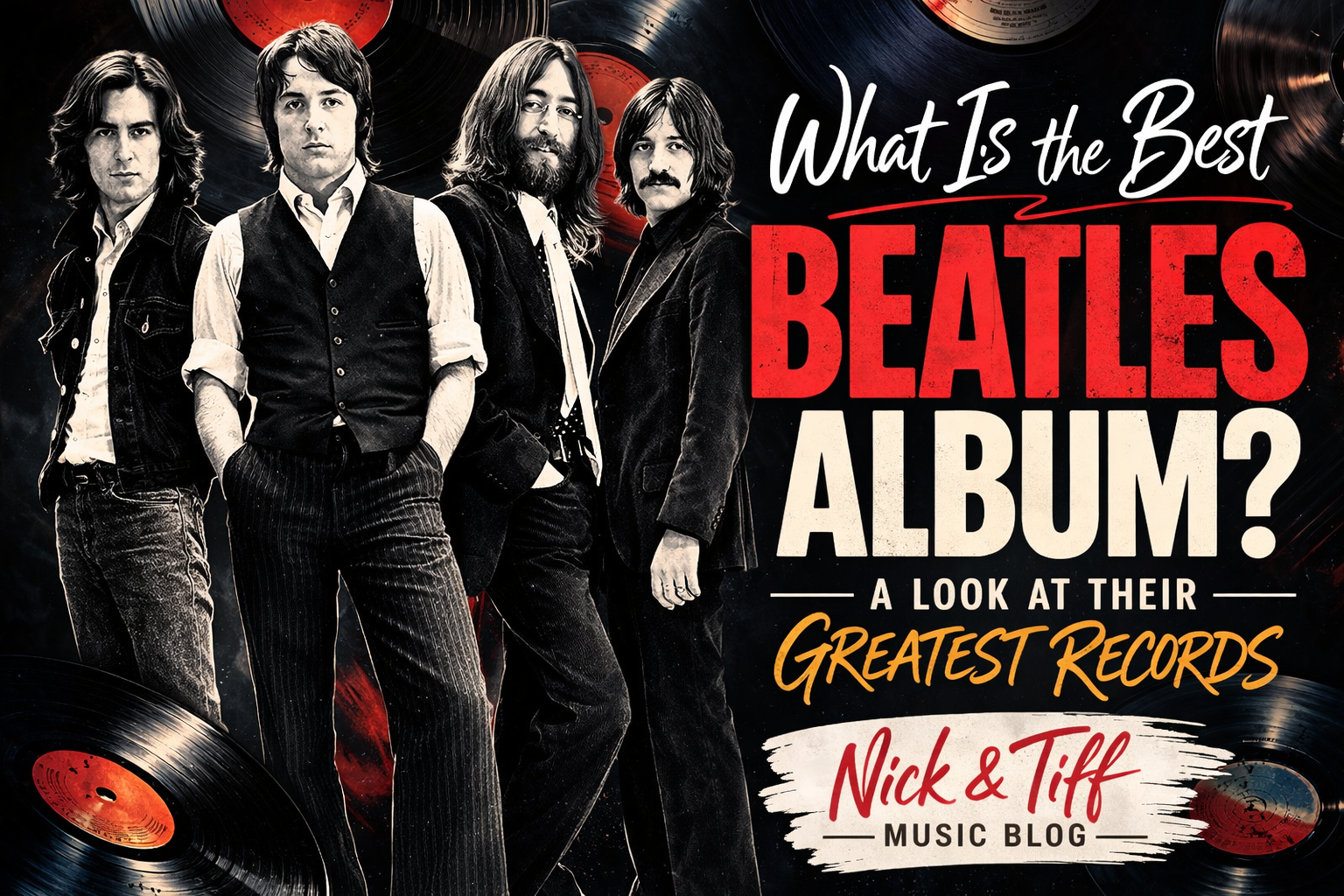
Few questions in music spark as much debate as which Beatles album is the best. Over the course of the 1960s, The Beatles released a series of albums that didn’t just succeed commercially — they redefined what a rock album could be.
What makes the question so difficult is that the band evolved rapidly from one album to the next. Their early records focused on tight pop songwriting, while their later albums explored everything from psychedelic experimentation to stripped-down rock.
In fact, many fans believe that once The Beatles reached 1965’s Rubber Soul, every album they released afterward could make a legitimate argument for being the greatest album ever made.
Explore more Beatles discussions, song meanings & reviews here.
What Is the Best Beatles Album?
There isn’t a single definitive answer to the question of the best Beatles album. However, several records consistently appear in the conversation depending on what listeners value most:
- Rubber Soul (1965) – the turning point where the band’s songwriting matured
- Revolver (1966) – groundbreaking experimentation combined with brilliant songwriting
- Sgt. Pepper’s Lonely Hearts Club Band (1967) – one of the most influential albums ever recorded
- Magical Mystery Tour (1967) – a colorful collection of psychedelic classics
- The White Album (1968) – an incredible display of Lennon and McCartney’s songwriting range
- Abbey Road (1969) – the most satisfying front-to-back listening experience
- Let It Be (1970) – a raw and emotional final chapter
Support Nick & Tiff Music: As an affiliate these links help keep the blog going at no extra cost to you – and we truly appreciate it! Thank you for supporting.
Shop Beatles Vinyl, CDs, Books & Merch
Let’s dive in and look at what makes several Beatles albums special, and why each one is often mentioned in the conversation about the band’s greatest work.
Rubber Soul (1965): The Turning Point
For many listeners, Rubber Soul marks the moment when The Beatles began to fully mature as songwriters.
Released in 1965, the album bridges the gap between the band’s earlier pop records and the more experimental work that would follow. Acoustic guitars, folk influences, and more introspective lyrics give the album a warmer and more reflective tone.
Songs like “Norwegian Wood,” “In My Life,” and “Michelle” show John Lennon and Paul McCartney beginning to explore more personal songwriting while still delivering unforgettable melodies.
It’s also the point where albums started to feel more cohesive. Rather than simply being a collection of singles, Rubber Soul plays like a complete artistic statement.
Because of this shift, many fans see Rubber Soul as the album where The Beatles truly entered their most legendary creative period.
Shop Rubber Soul on Vinyl & CD
Read our deep dive song reviews of “Norwegian Wood” & “In My Life.”
Norwegian Wood by The Beatles Meaning: A Sharp Song About Ego and Rejection
In My Life by The Beatles Meaning: The Beauty Behind a Timeless Classic
Revolver (1966): Experimentation Meets Brilliant Songwriting
If Rubber Soul opened the door creatively, Revolver blew it wide open.
Released in 1966, the album marks the point where The Beatles fully embraced the recording studio as an instrument. New sounds and recording techniques appear throughout the record.
“Tomorrow Never Knows” uses tape loops and hypnotic rhythms to create a psychedelic soundscape unlike anything heard in pop music before. “I’m Only Sleeping” features backwards guitar parts, while George Harrison’s “Love You To” introduces Indian classical instrumentation to the band’s sound.
Yet for all its experimentation, the album is packed with incredible songwriting. Tracks like “Eleanor Rigby,” “Here, There and Everywhere,” and “Taxman” remain some of the most beloved songs in the Beatles catalog.
Because it balances innovation with unforgettable songwriting, many critics consider Revolver one of the most perfectly crafted albums the band ever made.
Read our piece on Why Revolver Is The Beatles’ Most Underrated Masterpiece
Sgt. Pepper’s Lonely Hearts Club Band (1967): The Cultural Landmark
When people talk about albums that changed music history, Sgt. Pepper’s Lonely Hearts Club Band is almost always part of the conversation.
Released in 1967 during the height of the psychedelic era, the album pushed studio experimentation even further. Orchestral arrangements, tape manipulation, and elaborate production techniques helped create a listening experience unlike anything audiences had heard before.
Songs like “Lucy in the Sky with Diamonds,” “A Day in the Life,” and “Being for the Benefit of Mr. Kite!” showcased how far The Beatles had expanded the possibilities of studio recording.
Beyond the music itself, the album helped cement the idea that a rock album could be a complete artistic statement, influencing generations of artists that followed.
Read our full track-by-track album review of Sgt. Pepper.
Sgt. Pepper’s Lonely Hearts Club Band Album Review #36: The Beatles’ Psychedelic Masterpiece
Buy Sgt. Pepper’s Lonely Hearts Club Band on Vinyl & CD
Magical Mystery Tour (1967): Psychedelic Imagination
While Sgt. Pepper often gets the spotlight, Magical Mystery Tour captures another side of the Beatles’ psychedelic creativity.
Originally released as a double EP in the UK and later expanded into a full album in the United States, the record combines songs from the band’s surreal television film with several of their most famous singles.
The result is a colorful collection that includes classics like “Strawberry Fields Forever,” “Penny Lane,” “I Am the Walrus,” and “All You Need Is Love.”
The album moves freely between dreamy psychedelia, orchestral pop, and surreal lyricism, showing just how imaginative the band had become during this period.
Read our breakdown of “I Am the Walrus” here:
I Am the Walrus Meaning: The Beatles’ Strangest Psychedelic Song
Buy Magical Mystery Tour on Vinyl & CD
The Beatles (The White Album) (1968): Songwriting Range at Its Peak
If there’s one Beatles album that truly captures the range of John Lennon and Paul McCartney as songwriters, it may be The Beatles, better known as The White Album.
Released in 1968 as a sprawling double album, the record feels almost like a window into the individual creativity of each member of the band.
What makes the album remarkable is the dramatic contrast between songs written by the same songwriter.
Paul McCartney delivers the delicate acoustic beauty of “Blackbird,” a quiet and reflective song built around fingerpicked guitar. Yet on the same album he also unleashes “Helter Skelter,” a blistering blast of distorted guitars that helped influence the development of hard rock and heavy metal.
John Lennon shows a similar range. With the second song on The White Album he delivers the hypnotic and melodic “Dear Prudence,” built around layered acoustic guitars. But later he dives into the raw, stripped-down blues of “Yer Blues,” recorded in a tiny room at Abbey Road to create an intentionally gritty sound.
Moments like these highlight just how diverse Lennon and McCartney’s songwriting had become by 1968.
Rather than following a single concept, The White Album feels like two of the greatest songwriters in rock history exploring every creative direction they could imagine.
Read our deep dive track-by-track album review of The Beatles White Album.
The Beatles – The White Album (1968) | Album Review #9
Buy The White Album on Vinyl & CD
Abbey Road (1969): The Perfect Listening Experience
If the goal is simply to put on a Beatles album and enjoy it from start to finish, Abbey Road might be the easiest choice.
Released in 1969, it was the final album the band recorded together, and it feels like a fitting conclusion to their career.
The first half of the album includes some of the band’s most recognizable songs, including “Come Together,” “Something,” and “Here Comes the Sun.”
But the album’s most famous moment is the side-two medley, where a series of shorter songs blend together into one seamless musical journey.
The result is one of the most satisfying album finales in rock history, giving Abbey Road a unique place in the Beatles catalog.
Explore Abbey Road further with our full track-by-track album review & song reviews of “Here Comes the Sun” & “The End.”
Abbey Road Album Review #27: The Beatles’ Farewell Masterpiece
Here Comes the Sun Meaning: The Beatles’ Song About Hope After Hard Times
The End by The Beatles Meaning: Abbey Road’s Perfect Final Message
Let It Be (1970): A Raw and Emotional Farewell
Released in 1970, Let It Be arrived during a difficult moment in the Beatles’ history as the band was beginning to fall apart.
The project originally started as an attempt to return to a simpler style of recording, focusing on live performances rather than complex studio production.
Songs like “Two of Us,” “Get Back,” and “Across the Universe” reflect that stripped-down spirit.
At the center of the album is the title track, “Let It Be,” one of Paul McCartney’s most enduring songs — a piano-driven anthem that continues to resonate with listeners decades later.
While the album may not have the polished production of some earlier Beatles records, it captures the band in a raw and emotional moment near the end of their journey.
So What Is the Best Beatles Album?
In the end, choosing the best Beatles album often comes down to what you value most.
If you’re drawn to musical innovation, Revolver and Sgt. Pepper are hard to beat.
If you love thoughtful songwriting, Rubber Soul stands out as a turning point.
If you want to hear the incredible range of Lennon and McCartney, The White Album offers something completely unique.
And if you’re looking for the most satisfying album to play from beginning to end, Abbey Road may be the answer.
The truth is that once The Beatles reached Rubber Soul, every album they released from that point has a legitimate claim to being the greatest album of all time.
And that’s exactly what makes The Beatles’ catalog so remarkable.
The debate over the Best Beatles Album will continue for generations.
Like, comment, or share — and let us know what your favorite Beatles album is.
If you enjoyed this piece, you might enjoy our weekly music discussions, song meaning breakdowns, and full track-by-track album deep dives. You can subscribe below – it’s free.
Browse our articles by Bands & Artists
Bands & Artists | Explore Music Coverage by Artist – Nick & Tiff Music Blog
More From Nick & Tiff Music Blog
The Beatles – The White Album (1968) | Album Review #9
Abbey Road Album Review #27: The Beatles’ Farewell Masterpiece
Sgt. Pepper’s Lonely Hearts Club Band Album Review #36: The Beatles’ Psychedelic Masterpiece
Why Revolver Is The Beatles’ Most Underrated Masterpiece
The 10 Most Underrated Beatles Songs (In Chronological Order)
The Most Underrated Beatles Songs – Part 2 (11-20) (In Chronological Order)
I Am the Walrus Meaning: The Beatles’ Strangest Psychedelic Song
Here Comes the Sun Meaning: The Beatles’ Song About Hope After Hard Times
In My Life by The Beatles Meaning: The Beauty Behind a Timeless Classic
Blackbird Meaning & Song Review – The Beatles (1968)
A Day In The Life – The Beatles Song Review
Fixing a Hole Meaning: The Beatles’ Song About Clearing Your Mind
Yer Blues Meaning & Song Review — The Beatles (1968)
Eleanor Rigby (1966) Meaning & Song Review – The Beatles
Imagine (1971) Meaning & Song Review – John Lennon
Instant Karma! Meaning & Song Review – John Lennon (1970)
Same Vibes #2: Lennon & Cobain
What Is The Best Rolling Stones Album? Here’s What Each One Does Best
What Is the Best Led Zeppelin Album? Exploring the Band’s Greatest Records
Going to California – Meaning & Song Review – Led Zeppelin
Ramble On (1969) – Meaning & Song Review – Led Zeppelin
Immigrant Song (1970) – Meaning & Song Review – Led Zeppelin
Fool in the Rain – Meaning & Song Review – Led Zeppelin
Kashmir – Meaning & Song Review – Led Zeppelin (1975)
Led Zeppelin IV vs. The Dark Side of the Moon
The 10 Most Underrated Nirvana Songs (Chronological Order)
The 10 Most Underrated Rolling Stones Songs (In Chronological Order)
The Most Underrated Rolling Stones Songs – Part 2 (11–20) (In Chronological Order)
Paint It Black (1966) – Meaning & Song Review – The Rolling Stones
Gimme Shelter (1969) Meaning & Song Review – The Rolling Stones
Beast of Burden (1978) – Meaning & Song Review – The Rolling Stones
Dead Flowers Meaning & Song Review — The Rolling Stones (1971)
The Rolling Stones – Exile on Main St. (1972) | Album Review #11
Why Keith Richards Is My Favorite Guitarist of All Time
What Is the Best Bruce Springsteen Album? A Look at His Greatest Records
What Is the Best Neil Young Album? A Look at His Greatest Records
What Is the Best Bob Dylan Album? A Look at the Legendary Songwriter’s Greatest Records
What Is The Best Tom Petty Album? Exploring His Greatest Records
This piece is part of our Weekly Music Discussion, check out our page where we have all sorts of fun conversations and discuss all things Music…
Weekly Music Discussion | Nick & Tiff Music Blog
Explore more on the Homepage:
Nick & Tiff Music Blog – ALBUM & SONG REVIEWS – GEAR TALK & STORE UPDATES
Leave a Reply