
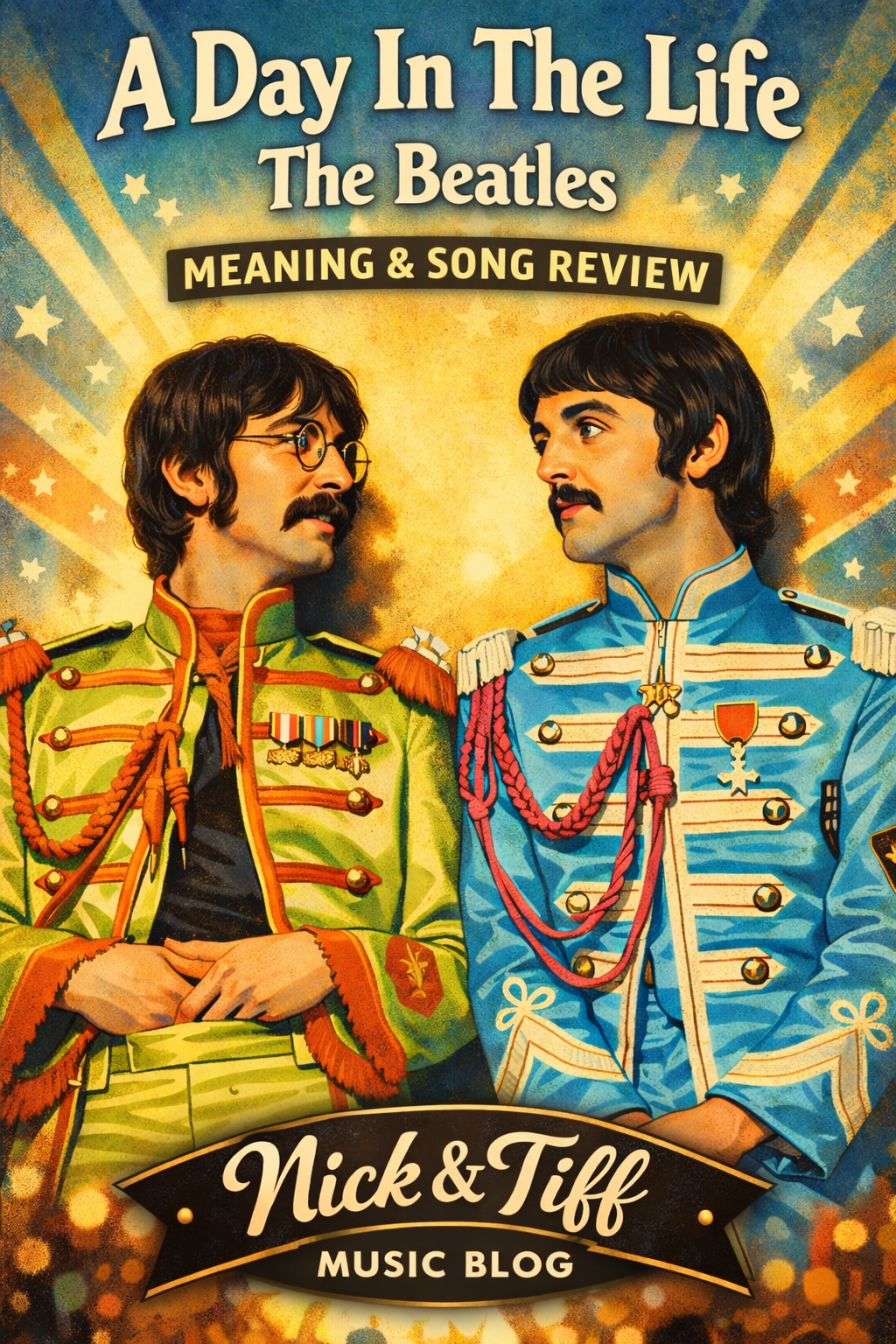
What Is “A Day in the Life” About?
At its core, A Day in the Life reflects a sense of emotional detachment in the modern world. The song moves between extraordinary events and everyday routines, suggesting that life often drifts between moments of awareness and numbness.
Rather than delivering a clear message or moral, the lyrics simply observe. News headlines, personal routines, and fleeting thoughts pass by almost casually, leaving the listener to interpret their meaning.
Serving as the haunting finale to Sgt. Pepper’s Lonely Hearts Club Band, the song feels less like a traditional pop track and more like an artistic statement — a moment when pop music fully embraced atmosphere, experimentation, and emotional depth.
The track’s structure perfectly mirrors this idea, combining John Lennon’s surreal, detached storytelling with Paul McCartney’s grounded snapshot of ordinary life.
Explore more Beatles song meaning and album reviews here.
Quick Details
- Song: A Day in the Life
- Artist: The Beatles
- Album: Sgt. Pepper’s Lonely Hearts Club Band
- Released: 1967
- Written by: John Lennon & Paul McCartney
- Why It Matters: Often considered one of the greatest songs ever recorded, A Day in the Life captures the contrast between the surreal and the mundane, blending Lennon’s dreamlike observations with McCartney’s everyday realism — and redefining what pop music could be.
What Inspired “A Day in the Life”?
Much of the song’s imagery came directly from real-life newspaper stories that caught John Lennon’s attention in early 1967.
One of the most famous inspirations was the tragic death of Tara Browne, a young Guinness heir who died in a car accident in London. Lennon read about the crash in the newspaper and transformed the headline into the opening verse’s haunting imagery about a fatal accident and the public’s detached reaction.
Other lines were drawn from everyday news stories and observations, reinforcing the feeling that the song is pieced together from fragments of real life.
Paul McCartney later contributed the middle section of the song, inspired by his own memories of everyday routine — waking up, rushing to catch the bus, and moving through the mechanical rhythm of daily life.
Together, these ideas created a song that feels like a collage of reality, where the extraordinary and the mundane exist side by side.
John Lennon’s Dreamlike Verses
Lennon’s sections of the song feel almost surreal. His lyrics unfold like a series of disconnected newspaper clippings drifting through the mind.
The opening verse introduces a tragic accident but describes it with a strange emotional distance, as if the narrator is observing the event rather than reacting to it. That detachment becomes part of the song’s power. Instead of dramatizing the moment, Lennon lets the quiet details speak for themselves.
Throughout these verses, the world feels both familiar and slightly distorted — a place where events happen, headlines appear, and people simply move on.
That emotional distance captures a deeper theme: the way modern life can sometimes make even shocking moments feel strangely routine.
Paul McCartney’s Everyday Interlude
Just as the listener sinks into Lennon’s dreamlike world, the song suddenly shifts.
Paul McCartney’s middle section brings the focus back to something completely ordinary — waking up, getting dressed, and rushing to catch the bus.
It’s intentionally mundane. In fact, that simplicity is exactly what makes the section so effective.
The contrast between Lennon’s surreal observations and McCartney’s everyday routine highlights the strange rhythm of life itself. One moment we are confronted with huge, world-shaking events, and the next we are simply trying to get through the morning.
That sudden shift between the profound and the trivial is one of the song’s most powerful ideas.
The Remarkable Contrast Between Lennon and McCartney
One of the most fascinating aspects of A Day in the Life is the dramatic contrast between John Lennon and Paul McCartney’s sections of the song.
Lennon’s verses feel slow, hazy, and reflective — almost like drifting through someone’s thoughts as they read the morning news. The music moves gently, allowing the surreal imagery to unfold at its own pace.
Then suddenly everything changes.
McCartney’s middle section bursts in with energy and urgency. The tempo quickens, the rhythm tightens, and the lyrics shift to something completely ordinary: waking up late, rushing out the door, and catching the bus.
On paper, the two sections almost feel like they belong to entirely different songs.
And yet somehow, they fit together perfectly.
That contrast is exactly what makes the track so powerful. Lennon’s dreamlike reflections and McCartney’s everyday routine represent two sides of the same reality — the strange way life moves between profound moments and simple daily habits.
Instead of clashing, the two perspectives complement each other, creating a song that feels bigger and more complex than either part could be on its own.
It’s one of the most brilliant examples of the Lennon–McCartney songwriting partnership, where two completely different creative voices combine to create something, neither could have written alone.
It’s hard to think of another song where two completely different musical ideas come together so seamlessly — which is part of what makes “A Day in the Life” feel so groundbreaking even decades later.
Support Nick & Tiff Music: As an affiliate these links help support the blog at no extra cost to you-and we truly appreciate it! Thank you for supporting.
Buy Sgt. Pepper’s Lonely Hearts Club Band on Vinyl & CD
Shop The Beatles Vinyl, CDs, Books, & Merch
The Revolutionary Orchestral Crescendo
What truly elevates A Day in the Life, however, is its sound.
Between the verses, the song erupts into massive orchestral crescendos that feel chaotic and unpredictable. The sound builds slowly, swelling into a storm of instruments before collapsing back into silence.
Producer George Martin helped bring this moment to life with an unusual idea. Instead of giving the orchestra traditional sheet music, he instructed the musicians to begin at the lowest note of their instrument and gradually climb to the highest.
Each player moved independently, creating a swirling wall of sound that grows increasingly chaotic.
Some of the classically trained musicians were skeptical of the approach — a few even laughed at the instructions — but when the final recording played back, the result was extraordinary.
The orchestral surge became one of the most recognizable moments in the entire Beatles catalog.
The Legendary Final Piano Chord
The song ends with one of the most famous moments in rock history.
After the final verse, a massive piano chord rings out and lingers for nearly a full minute, slowly fading into silence.
The chord was played by several people at once — John Lennon, Paul McCartney, Ringo Starr, and George Martin — all striking multiple pianos simultaneously to create a fuller, more powerful sound.
Engineers gradually raised the volume as the chord decayed, stretching the moment so that every last vibration could be heard.
By the end, the studio itself seems almost silent except for the faint echo of the sound fading away. It’s an ending that doesn’t so much resolve as it simply dissolves into quiet.
Why “A Day in the Life” Still Matters
More than fifty years later, A Day in the Life still feels remarkably modern.
The song is experimental without losing emotional depth. It’s reflective without being preachy, ambitious without feeling forced.
By combining surreal storytelling, everyday realism, orchestral experimentation, and innovative production techniques, the Beatles created something far beyond the boundaries of typical pop music.
Few songs manage to feel so expansive while remaining so personal.
That rare balance is exactly why A Day in the Life continues to be widely regarded as one of the greatest recordings in the history of popular music.
Like, comment, or share — and let us know your take in the comments.
If you enjoyed this piece, you might enjoy our weekly music discussions, song meaning breakdowns, and full track-by-track album deep dives. You can subscribe below – it’s free.
Browse our posts by Bands & Artists
Bands & Artists | Explore Music Coverage by Artist – Nick & Tiff Music Blog
More From Nick & Tiff Music Blog
What Is the Best Beatles Album? A Look at Their Greatest Records
The 10 Most Underrated Beatles Songs (In Chronological Order)
The Most Underrated Beatles Songs – Part 2 (11-20) (In Chronological Order)
Nowhere Man by The Beatles Meaning: John Lennon’s Song About Feeling Lost
In My Life by The Beatles Meaning: The Beauty Behind a Timeless Classic
Eleanor Rigby (1966) Meaning & Song Review – The Beatles
Why Revolver Is The Beatles’ Most Underrated Masterpiece
Sgt. Pepper’s Lonely Hearts Club Band Album Review #36: The Beatles’ Psychedelic Masterpiece
Abbey Road Album Review #27: The Beatles’ Farewell Masterpiece
The Beatles – The White Album (1968) | Album Review #9
Blackbird Meaning & Song Review – The Beatles (1968)
Yer Blues Meaning & Song Review — The Beatles (1968)
Here Comes the Sun Meaning: The Beatles’ Song About Hope After Hard Times
Fixing a Hole Meaning: The Beatles’ Song About Clearing Your Mind
Same Vibes #2: Lennon & Cobain
Same Vibes #1: The White Album & Vitalogy
Gimme Shelter (1969) Meaning & Song Review – The Rolling Stones
The 10 Most Underrated Rolling Stones Songs (In Chronological Order)
The Most Underrated Rolling Stones Songs – Part 2 (11–20) (In Chronological Order)
The Rolling Stones – Exile on Main St. (1972) | Album Review #11
Paint It Black (1966) – Meaning & Song Review – The Rolling Stones
Beast of Burden (1978) – Meaning & Song Review – The Rolling Stones
Dead Flowers Meaning & Song Review — The Rolling Stones (1971)
Why Keith Richards Is My Favorite Guitarist of All Time
Mama Kin – Aerosmith Song Review
Best of You – Foo Fighters Song Review
Over the Hills and Far Away – Led Zeppelin Song Review
Led Zeppelin IV vs. The Dark Side of the Moon
From Dylan to Springsteen to Zach Bryan: The Lineage of the American Songwriter
Check out our Song Review Archives:
Song Reviews | Nick & Tiff Music Blog
Explore more on the Homepage:
Nick & Tiff Music Blog – ALBUM & SONG REVIEWS – GEAR TALK & STORE UPDATES
Leave a Reply