
Quick Details
- Artist: Bob Dylan
- Album: The Freewheelin’ Bob Dylan
- Released: 1963
- Length: 6:49
So, what is the meaning of “A Hard Rain’s A-Gonna Fall”?
At first listen, the song feels apocalyptic — poisoned waters, dead oceans, bleeding hammers, burning hands, and a world full of fear. Because it was written during the Cold War, many listeners originally assumed the “hard rain” referred to nuclear fallout.
But Dylan later explained it wasn’t about one specific event. The “hard rain” is a storm of human suffering — war, injustice, racism, environmental destruction, poverty, and moral collapse — all gathering at once.
In other words: not a single catastrophe, but the feeling that the entire world is heading toward one.
The narrator isn’t predicting the end — he’s witnessing warning signs everywhere.
You can explore more of our Bob Dylan coverage here.
The Structure: A Folk Song Turned Into a Warning
The song uses a repeating dialogue:
“Oh, where have you been, my blue-eyed son?”
Each verse answers with surreal imagery instead of literal storytelling. Dylan borrowed this format from traditional British ballads, but instead of telling a medieval tragedy, he fills it with modern anxieties.
Every image feels symbolic rather than literal:
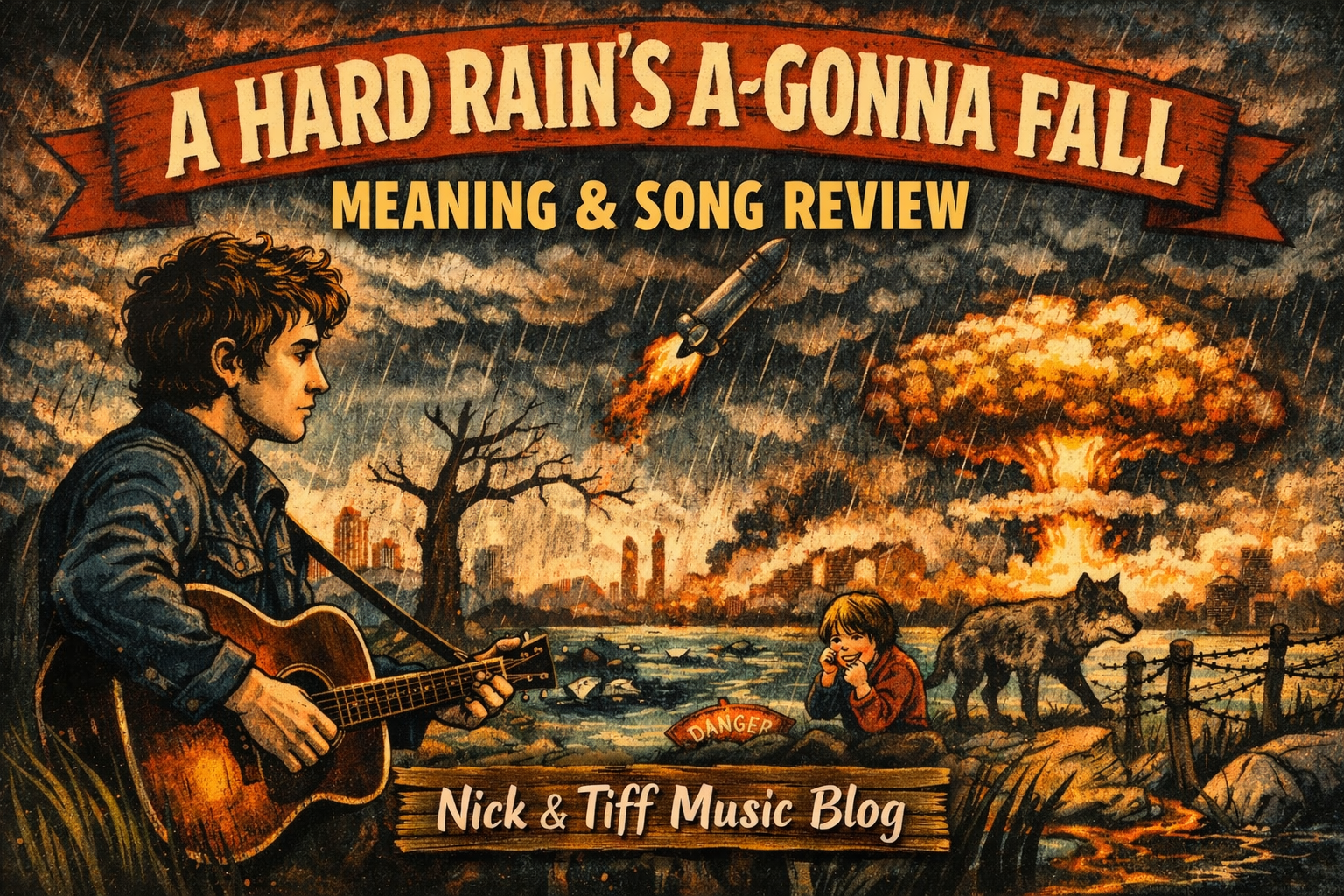
- “A newborn baby with wild wolves all around it” — innocence entering a violent world
- “Black branch with blood that kept drippin’” — America’s history of violence and racism
- “Pellets of poison are flooding their waters” — environmental and societal corruption
- “Ten thousand talkers whose tongues were all broken” — people silenced or unable to speak truth
The song becomes less about events and more about a moral landscape — a world losing its direction.
Why It Feels So Overwhelming
Unlike many protest songs that argue a specific point, this one accumulates images. Verse after verse piles on new horrors without relief.
That’s intentional.
Instead of telling you what to think, Dylan puts you inside the emotional experience of living in uncertain times — especially the early 1960s, when nuclear war, civil rights struggles, and political unrest were constant fears.
The listener becomes the “blue-eyed son,” witnessing everything and trying to process it.
The Final Verse: The Responsibility to Speak
After describing everything he’s seen, the narrator doesn’t run from it:
He says he’ll go back out before the rain starts falling.
That’s the key moment of the song.
The message isn’t despair — it’s obligation.
If you see injustice, you have to confront it. Silence is part of the problem.
Dylan positions the artist as a messenger:
not to fix the world, but to tell the truth about it.
Support Nick & Tiff Music: As an affiliate these links help support the blog at no extra cost to you — and we truly appreciate it! Thank you for supporting.
Buy The Freewheelin’ Bob Dylan Vinyl & CD
Shop Bob Dylan Vinyl, CD, Books, & Merch
See Bob Dylan Live:
See Bob Dylan Tour Dates & Tickets
Musical Feel
The arrangement is simple — just voice, guitar, and intensity — but it feels huge because of the relentless vocal delivery. Dylan doesn’t sing it softly; he almost declaims it like a warning speech.
The melody rarely resolves comfortably, which keeps the listener uneasy.
The song sounds like tension because the subject is tension.
Why the Song Endures
“A Hard Rain’s A-Gonna Fall” isn’t tied to 1963.
Every generation finds new meaning in it because the imagery is universal: corruption, inequality, violence, environmental damage, fear of the future.
It’s less a protest song about a moment and more a permanent alarm bell.
Dylan’s early protest-era songwriting helped shape generations of artists who followed — something we explore more in our piece on the lineage of the American songwriter.
Final Thoughts
This is one of Dylan’s earliest masterpieces — a song written by a young artist that already carries the weight of history.
Instead of offering solutions, it demands awareness.
The “hard rain” isn’t necessarily the end of the world — it’s the consequence of ignoring what we already see happening around us.
And the song’s final idea is clear:
The storm is coming.
What matters is whether anyone is willing to speak before it arrives.
Like, comment, or share — and let me know your take in the comments.
If you enjoyed this piece, you might enjoy our weekly music discussions, song meaning breakdowns, and full track-by-track album deep dives. You can subscribe below – it’s free.
Browse our articles by Bands & Artists
Bands & Artists | Explore Music Coverage by Artist – Nick & Tiff Music Blog
Related Reads
What Is the Best Bob Dylan Album? A Look at the Legendary Songwriter’s Greatest Records
Highway 61 Revisited Album Review #32: Bob Dylan Changes Rock Music Forever
The Freewheelin’ Bob Dylan (1963) – Bob Dylan | Album Review #12
Don’t Think Twice, It’s All Right Meaning: Not “Alright”—But Acceptance of What Was Meant to Be
Tangled Up in Blue (1975) Meaning & Song Review – Bob Dylan
Simple Twist of Fate Meaning & Song Review — Bob Dylan (1975)
Ballad of a Thin Man (1965) Meaning & Song Review – Bob Dylan
Tombstone Blues Lyrics Meaning: Bob Dylan’s Surreal Satire Explained
Desolation Row Lyrics Meaning: Bob Dylan’s Surreal Masterpiece Explained
Pledging My Time Lyrics Meaning: Bob Dylan’s Devotion Turns Obsessive
From Dylan to Springsteen to Zach Bryan
Same Vibes #3: Nebraska & Blood on the Tracks
What Is the Best Beatles Album? A Look at Their Greatest Records
What Is the Best Bruce Springsteen Album? A Look at His Greatest Records
What Is the Best Neil Young Album? A Look at His Greatest Records
What Is the Best Led Zeppelin Album? Exploring the Band’s Greatest Records
Bruce Springsteen – Born to Run (1975) Album Review #4
What Is the Best Beatles Album? A Look at Their Greatest Records
The 10 Most Underrated Rolling Stones Songs (In Chronological Order)
The 10 Most Underrated Beatles Songs (In Chronological Order)
Why Revolver Is The Beatles’ Most Underrated Masterpiece
The Beatles – The White Album (1968) | Album Review #9
Check out our Song Review Archives page:
Song Reviews | Nick & Tiff Music Blog
Explore more on the Homepage:
Nick & Tiff Music Blog – ALBUM & SONG REVIEWS – GEAR TALK & STORE UPDATES
Leave a Reply