
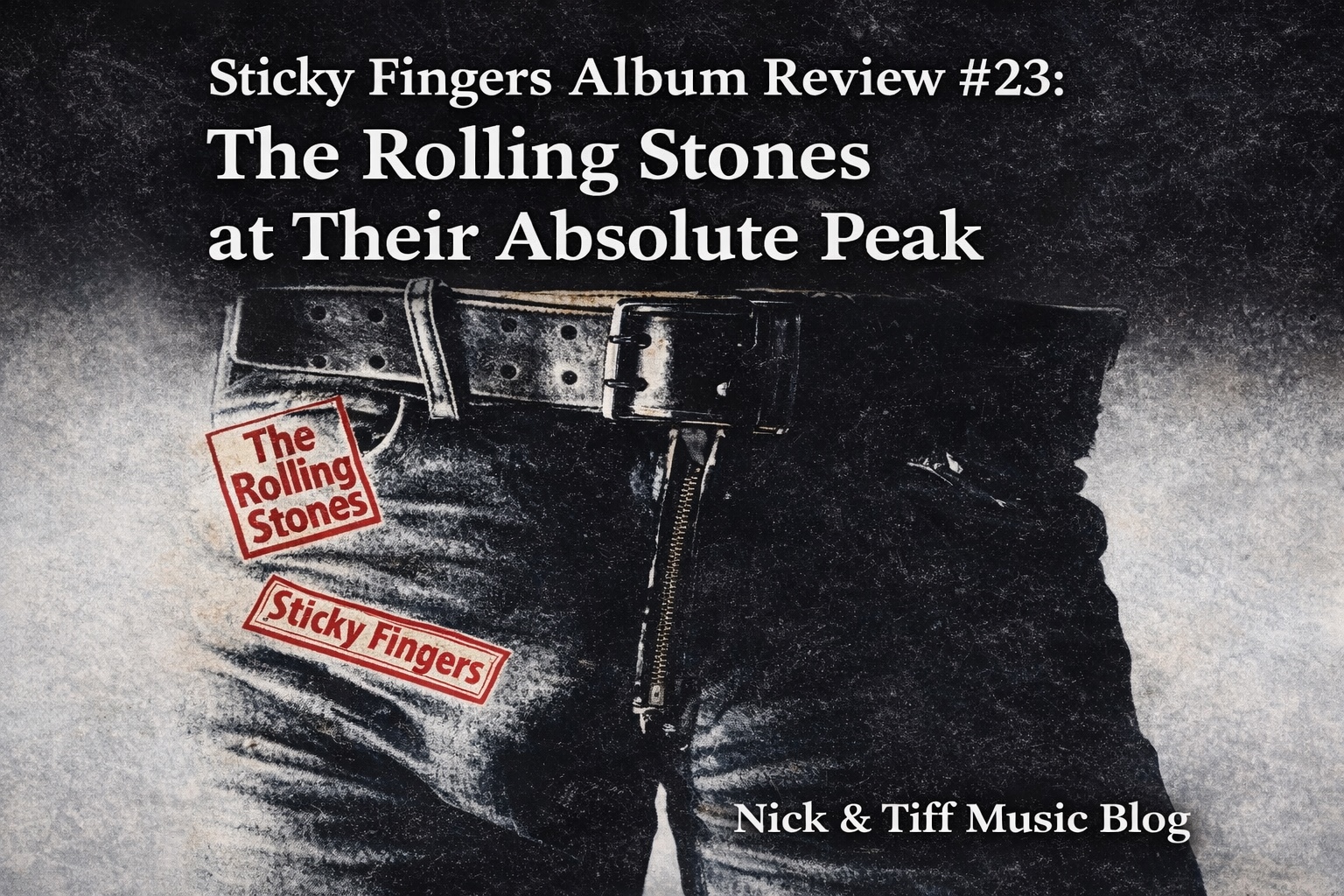
Sticky Fingers is widely considered one of The Rolling Stones’ best albums, blending blues, rock, country, and soul into a cohesive and confident sound.
By 1971, The Rolling Stones weren’t just refining their sound—they were fully embodying it.
There’s a looseness to the album, but nothing feels accidental. Every track carries its own identity while still fitting into a larger, cohesive mood. It’s confident without being forced—and that balance is what makes it one of the defining rock albums of its era.
It also marked a major turning point beyond the music—Sticky Fingers was their first release on Rolling Stones Records and the first to feature the now-iconic tongue and lips logo, signaling a band fully in control of its identity.
Explore more Rolling Stones articles here.
Quick Details
- Artist: The Rolling Stones
- Album: Sticky Fingers
- Released: April 23, 1971
- Length: 46 minutes
- Written by: Mick Jagger & Keith Richards
Sticky Fingers Track-by-Track Breakdown
1. Brown Sugar
There’s no slow build here—“Brown Sugar” hits immediately with one of the most recognizable riffs in rock.
Everything about it is driven forward by a relentless groove. Charlie Watts keeps things tight while Keith Richards pushes the track with relentless rhythm guitar. It’s energetic, raw, and intentionally provocative.
It sets the tone for the album perfectly: bold, unfiltered, and impossible to ignore.
2. Sway
“Sway” pulls things into a heavier, more emotional space.
Mick Taylor’s lead guitar gives the track its identity, adding a sense of lift and tension that contrasts with Jagger’s more restrained vocal. There’s a quiet intensity here that builds as the song unfolds.
It’s one of the album’s most overlooked highlights.
3. Wild Horses
“Wild Horses” shows just how effective the Stones can be when they hold back.
The arrangement is simple—acoustic guitars, steady pacing—but the emotional weight carries everything. Jagger’s vocal feels worn-in and genuine, which makes the song resonate without needing anything extra.
It’s one of their most enduring and universally relatable tracks.
Read more on “Wild Horses” in our deep dive song review.
Wild Horses by The Rolling Stones Meaning: Love That Refuses to Let Go
4. Can’t You Hear Me Knocking
This is where the album expands beyond traditional structure.
The opening section leans into classic Stones riff rock, but halfway through, it shifts into a loose, extended jam. Saxophone, percussion, and layered guitars create something far more exploratory.
It feels unplanned in the best way—like a band completely locked into the moment.
5. You Gotta Move
A direct blues cover, originally popularized by Mississippi Fred McDowell, that reconnects the album to its foundation.
There’s nothing flashy here—just slide guitar, space, and feel. It slows everything down and strips the sound back to its roots.
That simplicity gives the album a sense of grounding.
6. Bitch
“Bitch” brings the energy right back.
Driven by horns and a tight rhythm section, it’s punchy and direct. The band sounds completely in sync, delivering one of the album’s most aggressive moments.
It’s short, sharp, and doesn’t waste a second.
7. I Got the Blues
A soulful shift that leans into R&B influences.
Jagger takes center stage vocally, delivering a performance that feels vulnerable without losing control. The instrumentation builds gradually, adding depth without overpowering the track.
It adds a different emotional texture to the album.
8. Sister Morphine
One of the darkest moments on the record.
The arrangement is sparse and deliberate, creating a slow-building tension that never fully resolves. The lyrics are heavy, and the music leaves plenty of space for that weight to sit.
It’s not meant to be comfortable—and that’s exactly why it stands out.
9. Dead Flowers
A turn into country rock with a subtle edge.
One of the Stones’ most beloved country rock tracks.
The melody feels relaxed and easygoing, but the lyrics carry a sharper tone underneath. That contrast gives the song its personality.
It’s simple on the surface, but there’s more going on beneath it.
Explore “Dead Flowers” further here:
Dead Flowers Meaning: The Dark Truth Behind The Rolling Stones Song
10. Moonlight Mile
A reflective and understated closer.
Strings give the track a cinematic feel, while Jagger delivers one of his most introspective performances. There’s a sense of distance and comedown that fits perfectly as the album winds down.
It doesn’t try to end big—it ends thoughtfully.
Explore “Moonlight Mile” further here:
Moonlight Mile Lyrics Meaning: The Rolling Stones’ Most Reflective Song
Final Thoughts
Sticky Fingers works because it never feels forced.
Each track explores a different side of the band—rock, blues, country, and soul—but it all comes together naturally. There’s a confidence throughout the album that doesn’t rely on excess or overproduction.
It’s the sound of The Rolling Stones fully settled into who they are—and that’s what makes it timeless.
Support Nick & Tiff Music: As an affiliate these links help support the blog at no extra cost to you — and we truly appreciate it! Thank you for supporting.
Buy Sticky Fingers on Vinyl & CD
Shop The Rolling Stones Vinyl, CDs, Books & Merch
Sticky Fingers FAQ
Is Sticky Fingers considered the Rolling Stones’ best album?
It’s often part of the conversation alongside Exile on Main St., and Let it Bleed, with many fans pointing to Sticky Fingers as their most balanced and accessible album.
Why is Sticky Fingers so important in rock history?
It captures multiple styles—blues, rock, country, and soul—without sounding scattered, helping define what a cohesive rock album could be in the 1970s.
What are the most popular songs on Sticky Fingers?
“Brown Sugar,” “Wild Horses,” and “Can’t You Hear Me Knocking” are among the album’s most well-known tracks, each showcasing a different side of the band’s sound.
Is Sticky Fingers a good starting point for new listeners?
Yes—it offers a wide range of the band’s sound in one album, making it one of the easiest entry points into their catalog.
Explore more by Artist.
Bands & Artists | Explore Music Coverage by Artist – Nick & Tiff Music Blog
More From Nick & Tiff Music Blog
Foreign Tongues Album Review #44: The Rolling Stones Are on an Incredible Run
What Is The Best Rolling Stones Album? Here’s What Each One Does Best
In The Stars by The Rolling Stones Meaning: Fate, Luck, and Stones Swagger
Rough and Twisted by The Rolling Stones Meaning: New Stones With A Classic Stones Sound
Beggars Banquet Album Review #33: The Rolling Stones Find Their Dark Roots (1968)
Let It Bleed Album Review #28: The Rolling Stones’ Dark and Dangerous Masterpiece
The Rolling Stones – Exile on Main St. (1972) | Album Review #11
Hackney Diamonds: Why the Rolling Stones’ Latest Album Is Their Most Underrated
Sympathy for the Devil Meaning: The Rolling Stones’ Song About Blame, Evil, and Human Responsibility
Wild Horses by The Rolling Stones Meaning: Love That Refuses to Let Go
Dead Flowers Meaning: The Dark Truth Behind The Rolling Stones Song
Moonlight Mile Lyrics Meaning: The Rolling Stones’ Most Reflective Song
The 10 Most Underrated Rolling Stones Songs (In Chronological Order)
The Most Underrated Rolling Stones Songs – Part 2 (11–20) (In Chronological Order)
Tumblin’ Dice Lyrics Meaning: The Rolling Stones Song About Risk and Desire
Shattered Lyrics Meaning: The Rolling Stones’ Take on NYC in the 70s
Jumpin’ Jack Flash Lyrics Meaning: The Rolling Stones Turn Struggle Into Swagger
Doo Doo Doo Doo Doo (Heartbreaker) Meaning: The Rolling Stones’ Dark Song About Violence and Power
100 Years Ago Lyrics Meaning: The Rolling Stones Song About Growing Older
Paint It Black (1966) – Meaning & Song Review – The Rolling Stones
Gimme Shelter (1969) Meaning & Song Review – The Rolling Stones
Beast of Burden (1978) – Meaning & Song Review – The Rolling Stones
What Is “Loving Cup” About? The Rolling Stones’ Warm and Soulful Gem
Shine A Light Lyrics Meaning: The Rolling Stones’ Gospel Tribute to Brian Jones
Monkey Man Lyrics Meaning: The Rolling Stones Mock Their Own Reputation
Jigsaw Puzzle Lyrics Meaning: The Rolling Stones’ Sharp, Surreal Portrait of Chaos
Why Keith Richards Is My Favorite Guitarist of All Time
One of the Most Underrated Rolling Stones Songs: Saint of Me (1997)
Same Vibes #9: Mick Jagger & Steven Tyler
What Is the Best Beatles Album? A Look at Their Greatest Records
What Is the Best Bob Dylan Album? A Look at the Legendary Songwriter’s Greatest Records
What Is the Best Bruce Springsteen Album? A Look at His Greatest Records
What Is the Best Neil Young Album? A Look at His Greatest Records
What Is the Best Led Zeppelin Album? Exploring the Band’s Greatest Records
What Is The Best Tom Petty Album? Exploring His Greatest Records
The 10 Most Underrated Beatles Songs (In Chronological Order)
The Beatles – The White Album (1968) | Album Review #9
Explore our Album Reviews Archives page:
Album Reviews | Nick & Tiff Music Blog
If you enjoyed this piece, you might enjoy our weekly music discussions, song meaning breakdowns, and full track-by-track album deep dives. You can subscribe below – it’s free.
Explore more on the Homepage:
Nick & Tiff Music Blog – ALBUM & SONG REVIEWS – GEAR TALK & STORE UPDATES
Leave a Reply