
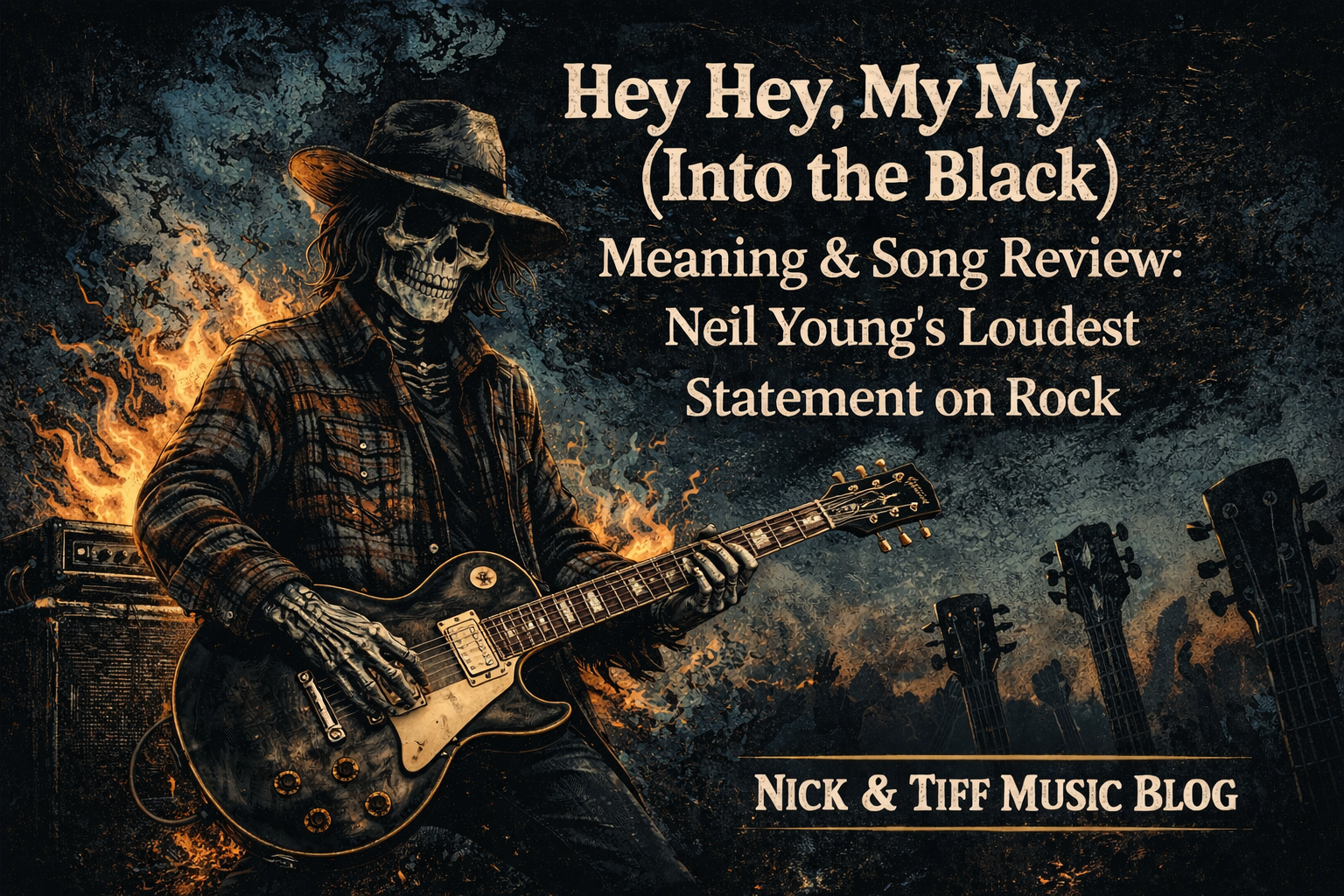
Neil Young’s “Hey Hey, My My (Into the Black)” is one of the most powerful statements ever made about rock music, artistic survival, and the fear of fading into irrelevance. Released in 1979 on Rust Never Sleeps, the song captures a moment when rock felt like it was being challenged—and responds with something louder, heavier, and impossible to ignore.
Driven by thick distortion and a relentless riff, this version of the song stands in sharp contrast to its acoustic counterpart, “My My, Hey Hey (Out of the Blue)”. Together, they frame the same idea from two different perspectives—but Into the Black is where that idea hits with full force.
Explore more Neil Young discussions, song meanings & reviews here.
Quick Details
- Artist: Neil Young
- Song: Hey Hey, My My (Into the Black)
- Album: Rust Never Sleeps
- Released: 1979
- Length: 5:17
- Written by: Neil Young
- Notable Counterpart: “My My, Hey Hey (Out of the Blue)”
What Is “Hey Hey, My My (Into the Black)” About?
“Hey Hey, My My (Into the Black)” by Neil Young is about staying relevant as an artist, embracing change, and refusing to fade into irrelevance as music evolves.
By the late 1970s, punk rock had disrupted everything. Artists from earlier in the decade were suddenly seen as outdated. Instead of resisting that shift, Neil Young embraced it, using this song to prove that rock music could still be dangerous, loud, and alive.
One of the song’s defining lines is:
“Rock and roll can never die”
It acts as both a belief and a challenge. The survival of rock depends on its ability to evolve—and on artists willing to push themselves into uncomfortable territory.
The Meaning Behind the Lyrics
“Out of the blue and into the black”
This line sets the emotional and sonic direction of the song.
- “Out of the blue” suggests clarity, calm, or familiarity
- “Into the black” represents distortion, chaos, and the unknown
It reflects a deliberate move away from safety into something raw and unpredictable—mirroring the shift in Young’s sound on this track.
“The king is gone but he’s not forgotten”
Often interpreted as a reference to Elvis Presley, this line reflects on legacy.
It acknowledges that legends remain influential even after they’re gone—but it also raises a deeper question:
Is being remembered enough, or does relevance require continued evolution?
“This is the story of Johnny Rotten”
Referencing Johnny Rotten of the Sex Pistols, this line brings punk directly into the conversation.
Rather than rejecting the new wave of music, the song recognizes it as the next chapter of rock. It connects generations—suggesting that rock survives not by staying the same, but by constantly reinventing itself.
“It’s better to burn out ’cause rust never sleeps”
This is the defining line of the electric version—and it carries a very different tone than it’s often remembered for.
Instead of presenting a simple choice between burning out or fading away, the line ties directly into the album’s central idea:
- “Burn out” represents intensity, risk, and creative fire
- “Rust never sleeps” suggests that stagnation is always creeping in
The message isn’t just about choosing intensity—it’s about the necessity of staying active, evolving, and resisting complacency before it takes hold.
Into the Black vs Out of the Blue: What’s the Difference?
“My My, Hey Hey (Out of the Blue)” presents the same core idea as “Hey Hey, My My (Into the Black)”—but in a completely different form.
Where Into the Black is loud, distorted, and confrontational, Out of the Blue is stripped down and reflective. The acoustic version feels almost like a warning, while the electric version sounds like the reaction.
Together, they frame the message of Rust Never Sleeps perfectly:
- The acoustic version introduces the idea
- The electric version drives it home
It’s not just two versions of the same song—it’s a complete artistic statement about change, survival, and the future of rock music.
The Sound: Loud, Raw, and Intentional
This version is built on distortion, repetition, and sheer volume.
- Heavy, fuzzy guitar tone—driven in part by Neil Young’s heavily modified Gibson Les Paul, known as “Old Black”
- Driving, almost hypnotic rhythm
- A loose, aggressive feel that borders on chaotic
It pushes closer to punk and even early grunge than traditional 70s rock. That sonic shift reinforces the song’s message—this isn’t nostalgia, it’s reinvention.
It doesn’t just sound loud—it sounds like a reaction to everything happening around it.
Neil Young also famously used “Old Black” on “Down by the River”. You can explore that song further here:
Down by the River Lyrics Meaning: The Dark Story Behind Neil Young’s Classic
This is where Neil Young earned the nickname “The Godfather of Grunge”. Read about some of the bands he had a big influence on:
The 10 Most Underrated Nirvana Songs (Chronological Order)
Ten (1991) Pearl Jam – Album Review #10
Story Behind the Song
“Hey Hey, My My” and its acoustic counterpart were influenced in part by Neil Young’s interactions with the experimental band Devo.
That experience introduced a new perspective on what rock music could be—less polished, more unconventional, and willing to challenge expectations. It helped shape Rust Never Sleeps, an album built around contrast: acoustic reflection on one side, electric intensity on the other.
Support Nick & Tiff Music: As an affiliate these links help keep the blog going at no extra cost to you, and we truly appreciate it! Thank you for supporting.
Buy Rust Never Sleeps on Vinyl & CD
Shop Neil Young Vinyl, CDs, Books & Merch
Why “Hey Hey, My My” Still Matters Today
The themes in this song remain just as relevant now as they were in 1979.
Every artist eventually faces the same challenge:
adapt or become irrelevant.
That tension is what has kept rock music evolving for decades.
This track doesn’t just acknowledge that reality—it confronts it head-on, choosing reinvention over comfort.
Final Thoughts
“Hey Hey, My My (Into the Black)” stands as one of Neil Young’s most defining statements.
It captures a moment when rock music was forced to evolve—and meets that moment head-on.
Loud, distorted, and unapologetic, it proves the point at the heart of the song:
Rock and roll can never die—but it can lose its edge if it stops evolving.
Like, comment, or share — and let me know your take in the comments.
If you enjoyed this piece, you might enjoy our weekly music discussions, song meaning breakdowns, and full track-by-track album deep dives. You can subscribe below – it’s free.
Browse our articles by Bands & Artists:
Bands & Artists | Explore Music Coverage by Artist – Nick & Tiff Music Blog
Related Reads
What Is the Best Neil Young Album? A Look at His Greatest Records
On The Beach Album Review #35: Neil Young’s Dark, Dusty Masterpiece
Old Man Lyrics Meaning: Neil Young’s Reflection on Time, Youth, and Perspective
After the Gold Rush Lyrics Meaning: Neil Young’s Dreamlike Vision of the Past and Future
Cinnamon Girl Lyrics Meaning: Neil Young’s Fever Dream Love Song Explained
Down by the River Lyrics Meaning: The Dark Story Behind Neil Young’s Classic
The Needle & the Damage Done Meaning: Neil Young’s Stark Song About Addiction
Vampire Blues Lyrics Meaning: Neil Young’s Sharp Attack on Greed and the Oil Industry
Walk On by Neil Young Meaning: How He Responded to Criticism After Harvest
On the Beach by Neil Young Meaning: Fame, Burnout, and Wanting to Disappear
Same Vibes #4: Eddie Vedder & Neil Young
What Is the Best Beatles Album? A Look at Their Greatest Records
What Is the Best Bob Dylan Album? A Look at the Legendary Songwriter’s Greatest Records
What Is the Best Led Zeppelin Album? Exploring the Band’s Greatest Records
Going to California – Meaning & Song Review – Led Zeppelin
Bruce Springsteen – Born to Run (1975) Album Review #4
Thunder Road (1975) – Meaning & Song Review – Bruce Springsteen
The 10 Most Underrated Beatles Songs (In Chronological Order)
Blackbird Meaning & Song Review – The Beatles (1968)
The Beatles – The White Album (1968) | Album Review #9
The 10 Most Underrated Rolling Stones Songs (In Chronological Order)
Dead Flowers Meaning & Song Review — The Rolling Stones (1971)
Paint It Black (1966) – Meaning & Song Review – The Rolling Stones
Tangled Up in Blue (1975) Meaning & Song Review – Bob Dylan
The Freewheelin’ Bob Dylan (1963) – Bob Dylan | Album Review #12
Ballad of a Thin Man (1965) Meaning & Song Review – Bob Dylan
A Hard Rain’s A-Gonna Fall – Bob Dylan (1963) Meaning & Song Review
From Dylan to Springsteen to Zach Bryan: The Lineage of the American Songwriter
Zach Bryan – With Heaven on Top (2026) | Album Review #6
Zach Bryan – (Self-Titled) (2023) Album Review #5
Something in the Orange (2022) – Meaning & Song Review – Zach Bryan
Check out our Song Review Archives page:
Song Reviews | Nick & Tiff Music Blog
Explore more on the Homepage:
Nick & Tiff Music Blog – ALBUM & SONG REVIEWS – GEAR TALK & STORE UPDATES
Leave a Reply