
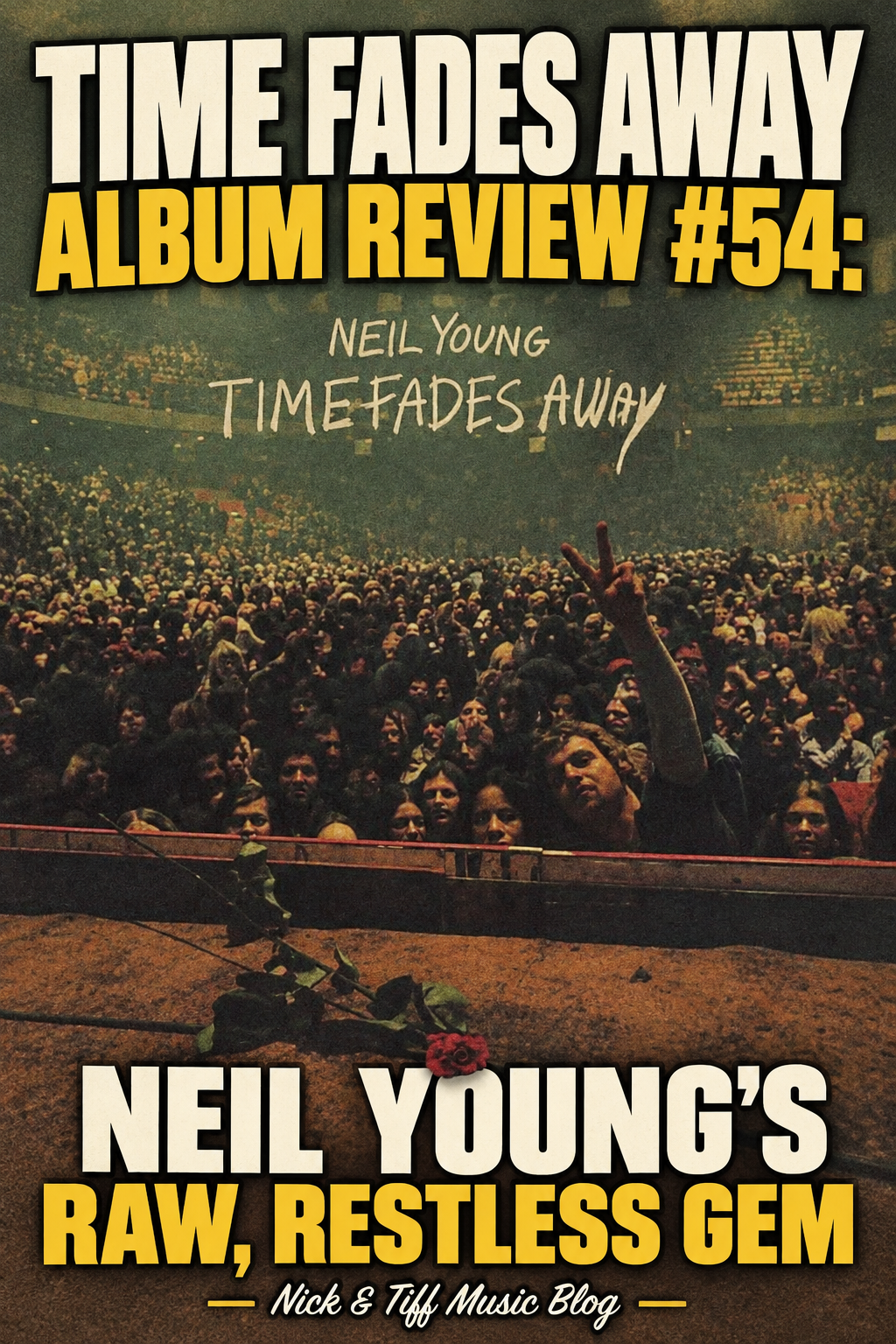
I really love Neil Young’s “ditch” era. Neil himself described heading for the ditch after the mainstream success of “Heart of Gold,” and the three albums associated with that period—Time Fades Away, On the Beach, and Tonight’s the Night—are some of my personal favorites. There’s a lot of beautiful songwriting in these records, and the performances get loud, loose, and a little unpredictable in the best way.
Released in 1973, Time Fades Away introduced eight previously unreleased songs through live recordings. That’s a pretty fascinating way to follow the enormous success of Harvest. Neil was taking listeners into unfamiliar material, and the performances captured all the energy and strain of playing it onstage.
What I enjoy most is how much ground this album covers in roughly 35 minutes. There’s rowdy country rock, tender piano playing, dark humor, and some deeply personal storytelling. The roughness is easy to hear, but so are the melodies. I personally love the rough sound of this album.
Explore more Neil Young discussions, song meanings & reviews here.
Quick Details
Artist: Neil Young
Album: Time Fades Away
Release Date: October 15, 1973
Label: Reprise Records
Genres: Country rock, folk rock, and hard rock
Producers: Neil Young and Elliot Mazer
Length: Approximately 35 minutes
Main Backing Band: The Stray Gators
Recording Period: Primarily the 1973 tour, with “Love in Mind” recorded in 1971
Tracklist
- Time Fades Away
- Journey Through the Past
- Yonder Stands the Sinner
- L.A.
- Love in Mind
- Don’t Be Denied
- The Bridge
- Last Dance
The Story Behind Time Fades Away
The tour behind Time Fades Away began with Neil carrying a difficult loss. Crazy Horse guitarist Danny Whitten had been expected to join him, but was sent home from rehearsals when he was unable to continue. Whitten died in November 1972, before the tour began.
The shows brought their own problems. There were tensions within the band, and Kenny Buttrey was replaced on drums by Johnny Barbata, who plays on the album’s full-band recordings. Later in the tour, David Crosby and Graham Nash joined to help support Neil, whose voice was struggling.
Knowing that history adds context to the record, but I don’t think you need to know every backstage detail to connect with it. You can hear the effort in the singing and the way the musicians push through these songs. There’s an edge to the performances that suits the material.
The choice to release these songs as live recordings also gives the album its own identity. These were the versions that introduced the material to record buyers. The piano songs and the louder band performances belong together because this is how Neil chose to present that collection of music.
What Neil Thought of the Album
Neil himself was much harder on Time Fades Away than I am. In a 1987 interview, he called it “the worst record I ever made,” while also acknowledging how well it documented what was happening to him. His comments show how closely the music remained tied to his experience of that difficult tour.
I find that interesting because the rawness is a big part of what I love about it. The strain in his voice and the loose performances make these songs so emotional to listen to. I can understand why he would hear difficult memories in this record, but as a fan, I hear an album with a lot of heart.
Support Nick & Tiff Music: As an affiliate these links help keep the blog going at no extra cost to you, and we truly appreciate it! Thank you for supporting.
Buy Time Fades Away Vinyl & CD on Amazon
Shop Neil Young Vinyl, CDs, Books & Merch
If you haven’t heard of nugs, it is an amazing platform for music lovers. You can stream audio and video of concerts. They do Livestreams, and they have a big archive of previous concerts on demand.
Time Fades Away Track by Track Review
1. Time Fades Away
The title track opens with a rowdy mix of rolling piano, guitar, and a rhythm section that keeps pushing forward. I love Jack Nitzsche’s piano here. It gives the song a barroom energy, while Neil’s harmonica cuts through with a scrappy little burst of its own. There’s so much happening around the vocal, and Neil sounds completely caught up in it.
Underneath that lively performance are troubled scenes involving addiction, hardship, and time slipping away. To me, the advice running through the song sounds like someone passing along lessons learned the hard way. That combination makes it such a compelling opener: the music gets you moving while the words give you something heavier to sit with.
Explore “Time Fades Away” further with our full song review here:
Time Fades Away by Neil Young: A Song Review of His Raw, Restless Rocker
2. Journey Through the Past
“Journey Through the Past” brings things down to Neil and his piano, and I love how clearly you can hear the tenderness in his singing. The melody has an easy, unhurried movement that gives him room to linger over the questions he’s asking.
The song imagines returning to someone while wondering whether their feelings will still be there. I hear affection mixed with the uncertainty that distance can create. You can picture going back, but you can’t guarantee that everything will be as you left it. Neil gets that across so naturally, without forcing a big emotional moment. It’s a beautiful example of how absorbing his quieter performances can be.
3. Yonder Stands the Sinner
“Yonder Stands the Sinner” brings the band charging back in. The guitar has a sharp bite, the rhythm has a loose swagger, and Neil’s vocal sounds wonderfully worked up. David Crosby joins him on vocals, giving the refrain an extra dose of wild energy. I really enjoy hearing their voices pushed into something this rough and restless.
The lyrics are more elusive here, with images of judgment and a mysterious sinner leaving plenty open to interpretation. I hear unease and accusation, but I wouldn’t pin it to one definite story. The performance is what grabs me most. Neil throws himself into the words, and the band makes this short song sound like it could come apart at any moment.
4. L.A.
“L.A.” paints a dark picture of Los Angeles, with smog, crowded freeways, and visions of the city being swallowed by disaster. I hear it as a warning about environmental destruction and the danger of carrying on as though nothing is wrong. The natural disasters make that warning even more dramatic, while Neil’s repeated questioning suggests frustration over whether anyone will listen before it’s too late.
I love how inviting the melody is against those unsettling images. There’s an easy sway to the performance, and Neil’s dry delivery gives the song a dark sense of humor. That combination really works for me. I get pulled in by the music, then find myself thinking about the destruction he’s describing and the indifference behind it.
5. Love in Mind
“Love in Mind” is a short piano song, but it’s one I always look forward to hearing. I love the warmth in Neil’s voice at the beginning and the way his delivery becomes more searching as he moves through it. The piano follows those shifts beautifully, giving the performance an intimacy that really draws me in.
To me, the song captures how love can lift your spirits while the world around you makes something so natural seem complicated. There’s tenderness, frustration, and a little helplessness in the way Neil sings it. Recorded in 1971, it fits comfortably among the later performances, and its brief running time leaves me wishing he would stay at the piano a little longer.
6. Don’t Be Denied
“Don’t Be Denied” follows Neil from his parents separating and his school days in Winnipeg through discovering music and finding success with Buffalo Springfield. The plainspoken storytelling makes those experiences easy to connect with, while the repeated title becomes a reminder to keep going through each setback. Neil also connected its writing to the period following Danny Whitten’s death, adding another layer to its determination.
I love the patience of this performance. The band gives the story room, and Ben Keith’s steel guitar adds a mournful touch around Neil’s voice. Each return to the refrain carries a little more weight. By the time success enters the picture, it’s clear that reaching a goal doesn’t make every struggle disappear. I hear Neil encouraging himself as much as anyone listening, and that’s what makes the song so moving.
Explore “Don’t Be Denied” further here:
Don’t Be Denied by Neil Young: A Song About Staying True to Yourself
7. The Bridge
“The Bridge” is a lovely, vulnerable performance built around piano, with harmonica adding to its lonely sound. Neil leaves plenty of space around his singing, and I love how the fragile parts of his voice become part of the song’s appeal.
I read the broken bridge as a connection between two people that has fallen apart. There’s sadness in looking at what’s been lost, but the thought of rebuilding leaves a little hope. It’s a simple image that carries a lot of emotion without needing much explanation. Coming after “Don’t Be Denied,” the song draws you into a quieter, more private moment before the band returns for the closer.
8. Last Dance
“Last Dance” gives the band room to stretch out, and I love how its circling groove suits the daily routine Neil describes. Waking up, getting moving, and heading back into another working day gradually become the starting point for a much louder frustration. His singing grows more insistent as the song develops, turning that familiar routine into something he wants to escape.
The guitar digs in while the piano keeps moving underneath, giving me plenty to follow throughout the longer performance. The repetition builds pressure, and the voices make the later passages sound like everyone is joining in the resistance. It’s a great way to finish the album, with Neil and the band pouring that restless energy into one final, drawn-out push.
Final Thoughts
I love how raw and emotional Time Fades Away is. There’s something about hearing Neil’s voice strain through these songs that makes me connect with them even more. I get caught up in the energy of the title track and “Last Dance,” but the quieter moments in-between hit just as hard. “Journey Through the Past” and “The Bridge” have a vulnerability that makes me want to stop what I’m doing and just listen.
That’s a big part of why I love his whole “ditch” period. Time Fades Away, On the Beach, and Tonight’s the Night each have their own sound, but there’s an emotional openness running through all three that really draws me in. The sadness, frustration, and determination come through so strongly, and there are beautiful melodies throughout. These are some of my favorite Neil Young albums because I love listening to them, rough edges and all.
Thanks for reading and supporting Nick & Tiff Music Blog, it really means a lot to us.
If you enjoyed this piece, you might enjoy our weekly music discussions, song meaning breakdowns, and full track-by-track album deep dives. You can subscribe below – it’s free.
FAQ About Time Fades Away
Why did Time Fades Away take so long to come out on CD?
Neil had a difficult relationship with the album and the tour it documented, and it remained absent from his CD catalog for decades. Its first official CD release arrived in 2017 as part of the Official Release Series Discs 5–8 box set.
Which albums make up Neil Young’s “Ditch Trilogy”?
The three albums are Time Fades Away, On the Beach, and Tonight’s the Night. In release order, they appeared in 1973, 1974, and 1975, although most of Tonight’s the Night was recorded before On the Beach.
Is “Journey Through the Past” also the name of another Neil Young album?
Yes. Neil released a soundtrack album called Journey Through the Past in 1972. The song of that name appears on Time Fades Away, which can make the two releases a little confusing when you’re first exploring his catalog.
Browse our articles by Bands & Artists:
Bands & Artists | Explore Music Coverage by Artist – Nick & Tiff Music Blog
More From Nick & Tiff Music Blog
What Is the Best Neil Young Album? A Look at His Greatest Records
On The Beach Album Review #35: Neil Young’s Dark, Dusty Masterpiece
Time Fades Away by Neil Young: A Song Review of His Raw, Restless Rocker
Walk On by Neil Young Meaning: How He Responded to Criticism After Harvest
On the Beach by Neil Young Meaning: Fame, Burnout, and Wanting to Disappear
Vampire Blues Lyrics Meaning: Neil Young’s Sharp Attack on Greed and the Oil Industry
Old Man Lyrics Meaning: Neil Young’s Reflection on Time, Youth, and Perspective
After the Gold Rush Lyrics Meaning: Neil Young’s Dreamlike Vision of the Past and Future
Hey Hey, My My (Into the Black) Meaning & Song Review: Neil Young’s Loudest Statement on Rock
Cinnamon Girl Lyrics Meaning: Neil Young’s Fever Dream Love Song Explained
Down by the River Lyrics Meaning: The Dark Story Behind Neil Young’s Classic
Same Vibes #4: Eddie Vedder & Neil Young
What Is the Best Bob Dylan Album? A Look at the Legendary Songwriter’s Greatest Records
What Is The Best Rolling Stones Album? Here’s What Each One Does Best
What Is the Best Bruce Springsteen Album? A Look at His Greatest Records
What Is the Best Beatles Album? A Look at Their Greatest Records
What Is the Best Led Zeppelin Album? Exploring the Band’s Greatest Records
What Is The Best Tom Petty Album? Exploring His Greatest Records
What Is the Best White Stripes Album? A Look at Every Era of Their Raw Garage Rock Genius
Blackbird Meaning & Song Review – The Beatles (1968)
Dead Flowers Meaning & Song Review — The Rolling Stones (1971)
Paint It Black (1966) – Meaning & Song Review – The Rolling Stones
Going to California Meaning: The Story Behind Led Zeppelin’s Acoustic Masterpiece
Bruce Springsteen – Born to Run (1975) Album Review #4
Thunder Road (1975) – Meaning & Song Review – Bruce Springsteen
The 10 Most Underrated Beatles Songs (In Chronological Order)
The Beatles – The White Album (1968) | Album Review #9
The 10 Most Underrated Rolling Stones Songs (In Chronological Order)
Tangled Up in Blue (1975) Meaning & Song Review – Bob Dylan
The Freewheelin’ Bob Dylan (1963) – Bob Dylan | Album Review #12
Ballad of a Thin Man (1965) Meaning & Song Review – Bob Dylan
A Hard Rain’s A-Gonna Fall – Bob Dylan (1963) Meaning & Song Review
From Dylan to Springsteen to Zach Bryan: The Lineage of the American Songwriter
Zach Bryan – With Heaven on Top (2026) | Album Review #6
Zach Bryan – (Self-Titled) (2023) Album Review #5
Something in the Orange (2022) – Meaning & Song Review – Zach Bryan
Check out our Song Review Archives page:
Song Reviews | Nick & Tiff Music Blog
Explore more on the Homepage:
Nick & Tiff Music Blog – ALBUM & SONG REVIEWS – GEAR TALK & STORE UPDATES
Leave a Reply