
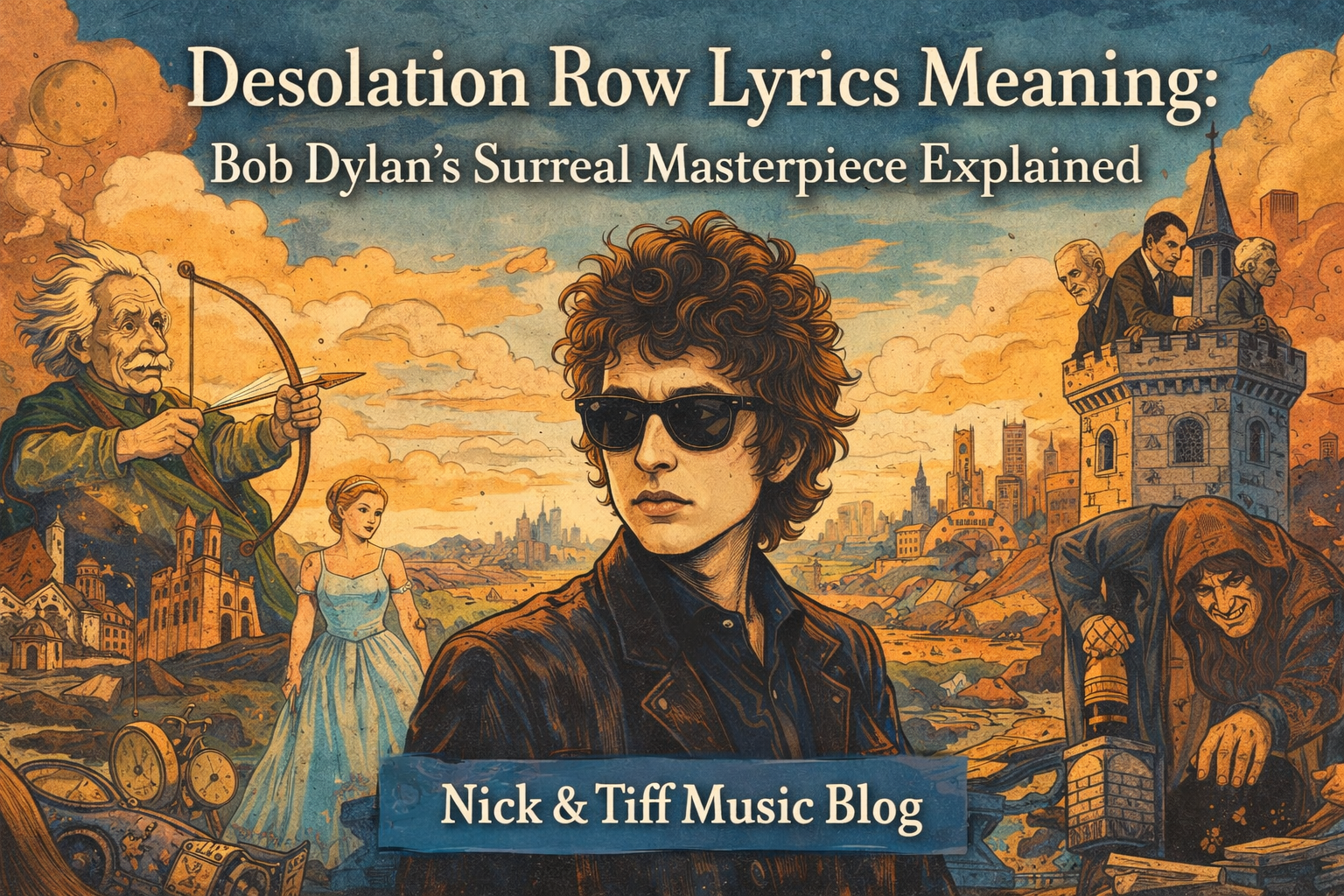
“Desolation Row” by Bob Dylan is one of the most mysterious and ambitious songs in his catalog. Released during Dylan’s groundbreaking mid-1960s creative peak, the song unfolds like a surreal journey through a strange street filled with literary characters, historical figures, and symbolic outsiders.
The meaning of “Desolation Row” isn’t meant to be taken as a straightforward story. Instead, Dylan uses a series of bizarre and poetic scenes to reflect on society, culture, and the chaos of the modern world. Through dark humor and vivid imagery, the song paints a strange portrait of humanity where intellectuals, fairy-tale figures, and cultural icons all collide.
At more than eleven minutes long, “Desolation Row” feels less like a traditional folk song and more like a piece of surreal literature set to music.
Explore more Bob Dylan discussions, song meanings, & reviews here.
Quick Details
Artist: Bob Dylan
Song: Desolation Row
Album: Highway 61 Revisited
Released: 1965
Length: 11:21
Written by: Bob Dylan
What Is “Desolation Row” by Bob Dylan About?
“Desolation Row” by Bob Dylan is a surreal and symbolic song that explores the chaos and contradictions of modern society. Rather than following a traditional narrative, Dylan builds an imagined street filled with strange characters, historical figures, and literary references, each representing different aspects of human behavior and culture.
At its core, the song reflects a world that feels disordered and uncertain. Authority figures appear powerless, intellectuals are caught in absurd situations, and cultural icons are placed into ironic or distorted roles. Through this shifting cast of characters, Dylan creates a vision of society that feels both dreamlike and unsettling.
Many listeners interpret the song as a reflection of cultural confusion during the mid-1960s, a time of political tension and rapid social change. Instead of offering clear answers, Dylan invites the listener to move through this surreal landscape and interpret its meaning for themselves.
The Strange Characters of Desolation Row
One of the most fascinating aspects of the song is the wide range of characters Dylan places on Desolation Row.
Among them are:
- Cinderella
- The Hunchback of Notre-Dame
- Ophelia
- Albert Einstein
- Robin Hood
- T. S. Eliot
- Ezra Pound
Each character appears in unusual and often ironic circumstances. For example, Einstein appears disguised as Robin Hood, suggesting a strange mix of intellect and rebellion. Meanwhile, the poets Eliot and Pound are portrayed fighting in a captain’s tower, creating a surreal image that blends literary history with absurdity.
These scenes transform Desolation Row into a symbolic stage where figures from across history and culture interact in strange and unpredictable ways.
The Sound of “Desolation Row”
Despite the song’s sprawling lyrics, the music itself is surprisingly restrained.
Unlike much of the electric rock sound found elsewhere on Highway 61 Revisited, “Desolation Row” is mostly acoustic. The arrangement includes:
- acoustic guitar
- light percussion
- bass
- delicate Spanish-style lead guitar
The subtle lead guitar was played by Nashville session musician Charlie McCoy, whose melodic playing gives the song a slightly exotic, almost flamenco-like feel.
The quiet arrangement allows Dylan’s lyrics to take center stage, turning the song into a long, unfolding piece of storytelling.
Literary Influences Behind “Desolation Row”
Many critics have pointed out similarities between Dylan’s writing in “Desolation Row” and the work of Beat Generation author Jack Kerouac.
In particular, Kerouac’s novel Desolation Angels — published in 1965 — shares a similar stream-of-consciousness style and philosophical tone. Both works move freely through strange characters, wandering ideas, and surreal imagery without following a traditional narrative.
While Dylan has never confirmed that Kerouac’s book directly inspired the song, the parallels between the two works have long fascinated critics and fans. Like Kerouac’s writing, Dylan’s lyrics feel spontaneous, poetic, and filled with cultural observation.
Possible Real-World Inspiration for the Title
Some historians believe the title “Desolation Row” may have been influenced by a tragic event from Dylan’s hometown of Duluth, Minnesota.
In 1920, three Black circus workers were lynched by a mob in what became known as the Duluth lynchings of 1920. Photographs of the event remained part of local history exhibits that Dylan would have been aware of growing up.
While Dylan has never confirmed the connection, some scholars believe the haunting phrase “Desolation Row” may reflect the disturbing images and moral questions surrounding that event.
A Portrait of Cultural Chaos
“Desolation Row” was written during a period of enormous cultural change in the United States.
The mid-1960s were marked by political tension, generational conflict, and rapid shifts in art, music, and social values. Dylan’s surreal lyrics capture the feeling of a world that no longer makes sense.
Instead of addressing these issues directly, Dylan uses satire and symbolism. Famous figures appear in strange situations, authority seems unreliable, and the line between wisdom and absurdity becomes blurred.
Through these dreamlike scenes, Dylan creates a portrait of a culture struggling to understand itself.
Support Nick & Tiff Music: As an affiliate these links help support the blog at no extra cost to you — and we truly appreciate it! Thank you for supporting.
Shop Bob Dylan Vinyl, CDs, Books & Merch
Buy Highway 61 Revisited on Vinyl & CD
See Bob Dylan on Tour:
See Bob Dylan Tour Dates & Tickets on Ticketmaster
Why “Desolation Row” Still Matters
More than half a century after its release, “Desolation Row” remains one of the most fascinating songs in Dylan’s catalog.
Part of the song’s enduring appeal lies in its openness to interpretation. Some listeners hear political commentary, while others see philosophical reflections on art, culture, and human nature.
The song’s surreal imagery invites listeners to return to it again and again, discovering new meanings each time.
Final Thoughts
“Desolation Row” stands as one of Bob Dylan’s most ambitious creations. Combining surreal storytelling, literary references, and subtle acoustic music, Dylan crafted a song that feels more like a piece of poetry than a typical folk track.
By filling his imaginary street with characters from across history and literature, Dylan turns Desolation Row into a strange mirror of society itself — a place where brilliance, absurdity, and human contradiction all exist side by side.
More than fifty years later, the street Dylan imagined still feels oddly familiar.
Like, comment, or share — and let me know your take in the comments.
If you enjoyed this piece, you might enjoy our weekly music discussions, song meaning breakdowns, and full track-by-track album deep dives. You can subscribe below – it’s free.
Browse our articles by Bands & Artists:
Bands & Artists | Explore Music Coverage by Artist – Nick & Tiff Music Blog
Related Reads
What Is the Best Bob Dylan Album? A Look at the Legendary Songwriter’s Greatest Records
Highway 61 Revisited Album Review #32: Bob Dylan Changes Rock Music Forever
The Freewheelin’ Bob Dylan (1963) – Bob Dylan | Album Review #12
Tombstone Blues Lyrics Meaning: Bob Dylan’s Surreal Satire Explained
Tangled Up in Blue (1975) Meaning & Song Review – Bob Dylan
Simple Twist of Fate Meaning & Song Review — Bob Dylan (1975)
Shelter from the Storm Lyrics Meaning: Bob Dylan’s Search for Redemption
Same Vibes #3: Nebraska & Blood on the Tracks
Don’t Think Twice, It’s All Right Meaning: Not “Alright”—But Acceptance of What Was Meant to Be
A Hard Rain’s A-Gonna Fall – Bob Dylan (1963) Meaning & Song Review
Ballad of a Thin Man (1965) Meaning & Song Review – Bob Dylan
Pledging My Time Lyrics Meaning: Bob Dylan’s Devotion Turns Obsessive
From Dylan to Springsteen to Zach Bryan: The Lineage of the American Songwriter
Same Vibes #3: Nebraska & Blood on the Tracks
Bruce Springsteen – Born to Run (1975) Album Review #4
The 10 Most Underrated Rolling Stones Songs (In Chronological Order)
What Is the Best Beatles Album? A Look at Their Greatest Records
The 10 Most Underrated Beatles Songs (In Chronological Order)
Why Revolver Is The Beatles’ Most Underrated Masterpiece
The Beatles – The White Album (1968) | Album Review #9
The 10 Most Underrated Nirvana Songs (Chronological Order)
Check out our Song Review Archives page:
Song Reviews | Nick & Tiff Music Blog
Explore more on the Homepage:
Nick & Tiff Music Blog – ALBUM & SONG REVIEWS – GEAR TALK & STORE UPDATES
Leave a Reply