
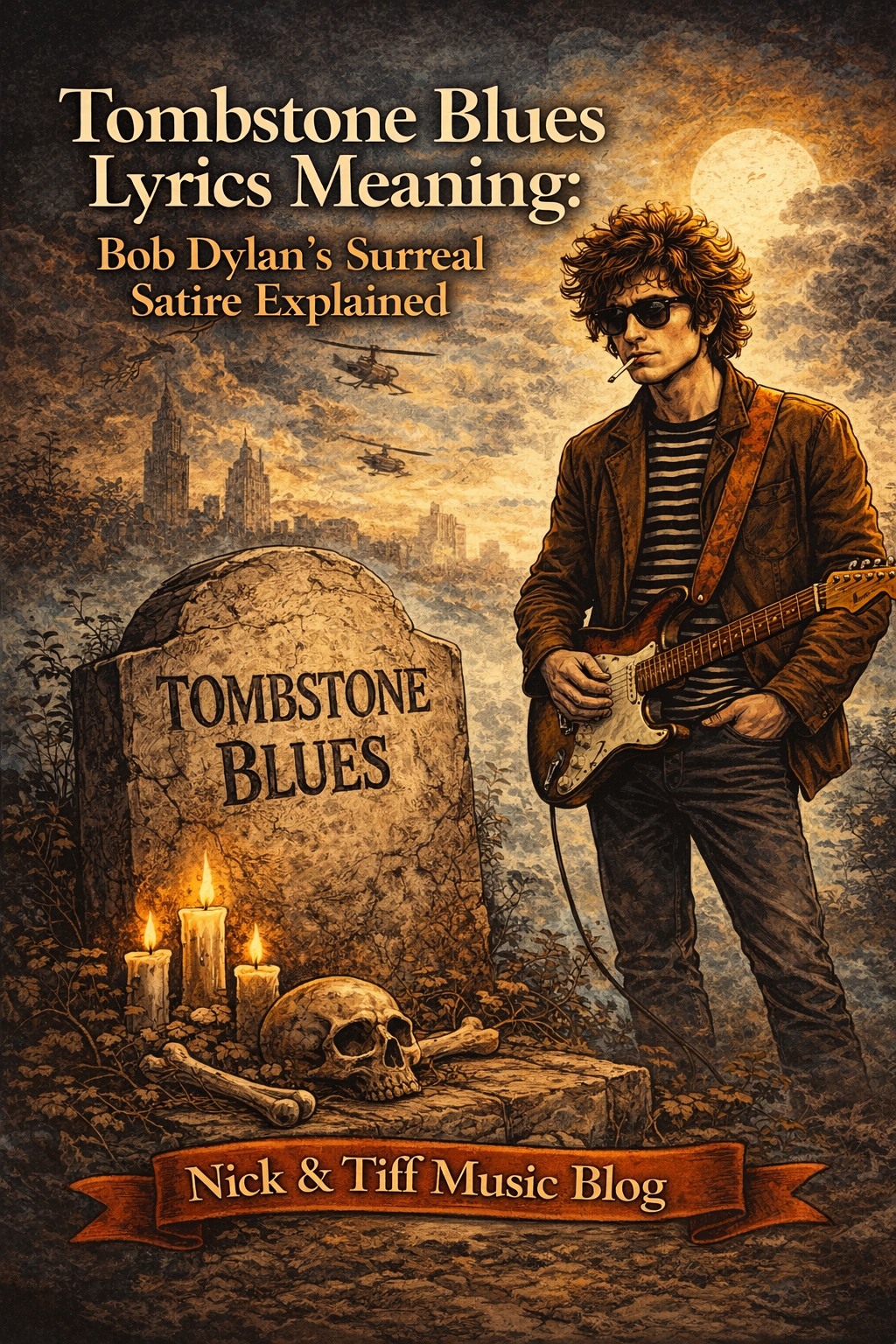
When Bob Dylan released “Tombstone Blues” in 1965 on Highway 61 Revisited, he delivered one of the wildest and most surreal songs of his career. Packed with rapid-fire imagery, strange characters, and biting humor, the song feels chaotic at first listen.
But beneath the absurd scenes and shifting characters lies a sharp critique of politics, hypocrisy, and the cultural turmoil of the mid-1960s. Dylan blends blues structure with surrealist poetry, creating a song that feels both playful and unsettling.
“Tombstone Blues” may not always receive the same attention as songs like “Like a Rolling Stone” or “Ballad of a Thin Man,” but it stands as one of the most fascinating lyrical experiments on Highway 61 Revisited.
Explore more Bob Dylan discussions, song meanings & album reviews here.
Quick Details
Song: Tombstone Blues
Artist: Bob Dylan
Album: Highway 61 Revisited
Released: 1965
Written by: Bob Dylan
Length: 5:58
Genre: Folk Rock / Blues Rock
Story Behind “Tombstone Blues”
“Tombstone Blues” was recorded during the famous sessions for Highway 61 Revisited in the summer of 1965, a period when Bob Dylan was rapidly redefining his sound and songwriting approach.
Only a few months earlier, Dylan had shocked many fans by performing with electric instruments at the Newport Folk Festival. That moment symbolized a turning point in his career, and the sessions that produced Highway 61 Revisited fully embraced this new direction.
“Tombstone Blues” captures Dylan leaning heavily into surreal imagery and rapid-fire lyric writing. Influenced by Beat poetry and writers like Allen Ginsberg, Dylan filled the song with strange characters, exaggerated scenarios, and dark humor.
Rather than telling a traditional story, Dylan built the song as a whirlwind of scenes that reflect the chaotic cultural and political climate of the mid-1960s. The song’s absurd imagery — historical figures in bizarre situations and authority figures behaving badly — allowed Dylan to critique power, hypocrisy, and social tension without delivering a direct political message.
The result is one of the most energetic and unpredictable songs on Highway 61 Revisited, perfectly capturing the creative explosion Dylan was experiencing during this era.
What Is “Tombstone Blues” by Bob Dylan About?
Pinning down the “Tombstone Blues lyrics meaning” isn’t easy, as the song’s strange imagery can feel almost impossible to decode on a literal level.
Rather than telling a straightforward story, Dylan creates a surreal landscape filled with bizarre scenarios and historical figures. In this strange world, characters like John the Baptist, the Commander-in-Chief, and even Paul Revere’s horse appear in absurd situations.
The effect is intentional. Dylan uses exaggerated and sometimes humorous imagery to highlight how society, politics, and authority can feel equally absurd.
The “tombstone blues” themselves can be interpreted as a feeling of cultural decay — the sense that the world has become so chaotic that the only response is a dark, sarcastic laugh.
While “Tombstone Blues” never directly mentions the Vietnam War, the song’s chaotic tone and portrayal of authority figures can feel closely tied to the political climate of the mid-1960s. Lines like the Commander-in-Chief “dropping a barbell” and declaring that “the sun’s not yellow, it’s chicken” suggest a kind of exaggerated toughness that borders on absurdity. Rather than making a direct protest statement, Dylan seems to capture a world where power, truth, and logic have all become unstable.
Key Lyrics in “Tombstone Blues” Explained
One of the best ways to understand “Tombstone Blues” is to look at a few of its most striking lines. While the song doesn’t follow a clear narrative, certain moments stand out and help reveal its deeper themes.
“The sun’s not yellow, it’s chicken”
This line is one of the most memorable in the song, and it perfectly captures Dylan’s sense of humor. An image that reinforces the theme of macho bravado and performative strength. It feels like exaggerated toughness, as if he’s trying to project authority through sheer attitude. Coming from a figure who is also chasing a fly, the moment turns into satire. He comes across as distracted, unfocused, and willing to pick a fight with anything — no matter how trivial or absurd — just to appear strong. It’s a sharp portrayal of power.
“The Commander-in-Chief answers him while chasing a fly”
This image is both subtle and revealing. On one level, chasing the fly feels like a strange kind of power move — an attempt to assert control over even the smallest nuisance. But at the same time, it highlights a lack of focus, as the Commander-in-Chief is distracted by something trivial while still trying to project authority. Paired with his exaggerated, macho response, the moment suggests a leader who is both performative and unfocused — willing to pick a fight with anything, even something meaningless, just to appear strong.
“John the Baptist, after torturing a thief”
Dylan takes a traditionally moral or religious figure and places him in a disturbing, contradictory role. This reversal highlights how even institutions meant to represent good can become corrupted or distorted in a chaotic world.
“Mama’s in the factory… I’m in the kitchen with the tombstone blues”
The recurring chorus grounds the song in something more real. While the verses spiral into surreal imagery, these lines suggest everyday struggle and disillusionment — a sense of being stuck in a world that feels broken and out of control.
The Surreal Characters and Imagery
One of the most striking aspects of “Tombstone Blues” is Dylan’s rapid stream of bizarre scenes.
These characters don’t exist to form a coherent narrative. Instead, they function more like symbols within a surreal collage.
This style reflects Dylan’s increasing interest in beat poetry, surrealism, and absurdist writing, influences that also shaped other songs from this period.
The chaotic parade of characters mirrors a world that feels equally chaotic.
The Satire Beneath the Madness
Despite its humor and absurdity, “Tombstone Blues” contains a strong undercurrent of satire.
Dylan frequently targets institutions of power — political leaders, religion, and authority figures — portraying them as ridiculous or morally compromised. The exaggeration highlights the hypocrisy Dylan saw in American culture during the 1960s.
Lines referencing war, punishment, and corruption hint at deeper anxieties about power and violence. The surreal presentation allows Dylan to critique these themes while avoiding direct political commentary.
Instead of preaching, he exposes the madness through humor.
The Sound of Highway 61 Revisited
Musically, “Tombstone Blues” captures the electric energy of Dylan’s mid-1960s transformation.
The song rides on a driving blues groove powered by electric guitars and pounding drums. Dylan’s vocal delivery is fast and relentless, matching the rapid pace of the lyrics.
This combination of raw rock instrumentation and surreal lyricism became one of the defining sounds of Highway 61 Revisited, an album that helped reshape the boundaries of folk and rock music.
“Tombstone Blues” may not be the album’s most famous track, but it perfectly represents the chaotic creativity of that era.
Read our full track-by-track album review of Highway 61 Revisited here:
Highway 61 Revisited Album Review #32: Bob Dylan Changes Rock Music Forever
Support Nick & Tiff Music: As an affiliate these links help support the blog at no extra cost to you — and we truly appreciate it! Thank you for supporting.
Buy Highway 61 Revisited Vinyl & CD
Shop Bob Dylan Vinyl, CDs, Books & Merch
See Bob Dylan Live:
See Bob Dylan Tour Dates & Tickets
Final Thoughts
“Tombstone Blues” is the kind of Bob Dylan song that gets better the more time you spend with it. At first, it can feel like a rush of strange names, wild images, and sharp one-liners. But after a few listens, the chaos starts to feel intentional — like Dylan is pulling you into a world where everything is moving too fast to make perfect sense.
That is part of what makes the song so fun to return to. It does not need to be decoded line by line to be powerful. The energy, humor, and nervous tension all work together, giving “Tombstone Blues” a life of its own.
It may be one of the strangest songs on Highway 61 Revisited, but that strangeness is exactly what makes it memorable. For fans, “Tombstone Blues” is Dylan at his most electric, unpredictable, and wildly imaginative.
FAQ About “Tombstone Blues”
What is Tombstone Blues by Bob Dylan about?
A surreal and satirical look at power, authority, and social chaos, often interpreted as reflecting the political climate of the 1960s, including the Vietnam War.
What album is Tombstone Blues on?
It appears on Highway 61 Revisited (1965).
Is Tombstone Blues a protest song?
Yes, while not a traditional protest song, it contains strong elements of political satire and social commentary.
Like, comment, or share — and let me know your take in the comments.
If you enjoyed this piece, you might enjoy our weekly music discussions, song meaning breakdowns, and full track-by-track album deep dives. You can subscribe below – it’s free.
Browse our articles by Bands & Artists:
Bands & Artists | Explore Music Coverage by Artist – Nick & Tiff Music Blog
Related Reads
What Is the Best Bob Dylan Album? A Look at the Legendary Songwriter’s Greatest Records
The Freewheelin’ Bob Dylan (1963) – Bob Dylan | Album Review #12
Highway 61 Revisited Album Review #32: Bob Dylan Changes Rock Music Forever
Desolation Row Lyrics Meaning: Bob Dylan’s Surreal Masterpiece Explained
Tangled Up in Blue (1975) Meaning & Song Review – Bob Dylan
Same Vibes #3: Nebraska & Blood on the Tracks
Simple Twist of Fate Meaning & Song Review — Bob Dylan (1975)
Shelter from the Storm Lyrics Meaning: Bob Dylan’s Search for Redemption
Ballad of a Thin Man (1965) Meaning & Song Review – Bob Dylan
A Hard Rain’s A-Gonna Fall – Bob Dylan (1963) Meaning & Song Review
Pledging My Time Lyrics Meaning: Bob Dylan’s Devotion Turns Obsessive
From Dylan to Springsteen to Zach Bryan: The Lineage of the American Songwriter
What Is the Best Beatles Album? A Look at Their Greatest Records
What Is the Best Neil Young Album? A Look at His Greatest Records
What Is the Best Led Zeppelin Album? Exploring the Band’s Greatest Records
Going to California – Meaning & Song Review – Led Zeppelin
Bruce Springsteen – Born to Run (1975) Album Review #4
Thunder Road (1975) – Meaning & Song Review – Bruce Springsteen
Zach Bryan – With Heaven on Top (2026) | Album Review #6
Zach Bryan – (Self-Titled) (2023) Album Review #5
Something in the Orange (2022) – Meaning & Song Review – Zach Bryan
The 10 Most Underrated Rolling Stones Songs (In Chronological Order)
Dead Flowers Meaning & Song Review — The Rolling Stones (1971)
The 10 Most Underrated Beatles Songs (In Chronological Order)
Why Revolver Is The Beatles’ Most Underrated Masterpiece
The Beatles – The White Album (1968) | Album Review #9
Check out our Song Review Archives page:
Song Reviews | Nick & Tiff Music Blog
Explore more on the Homepage:
Nick & Tiff Music Blog – ALBUM & SONG REVIEWS – GEAR TALK & STORE UPDATES
Leave a Reply