
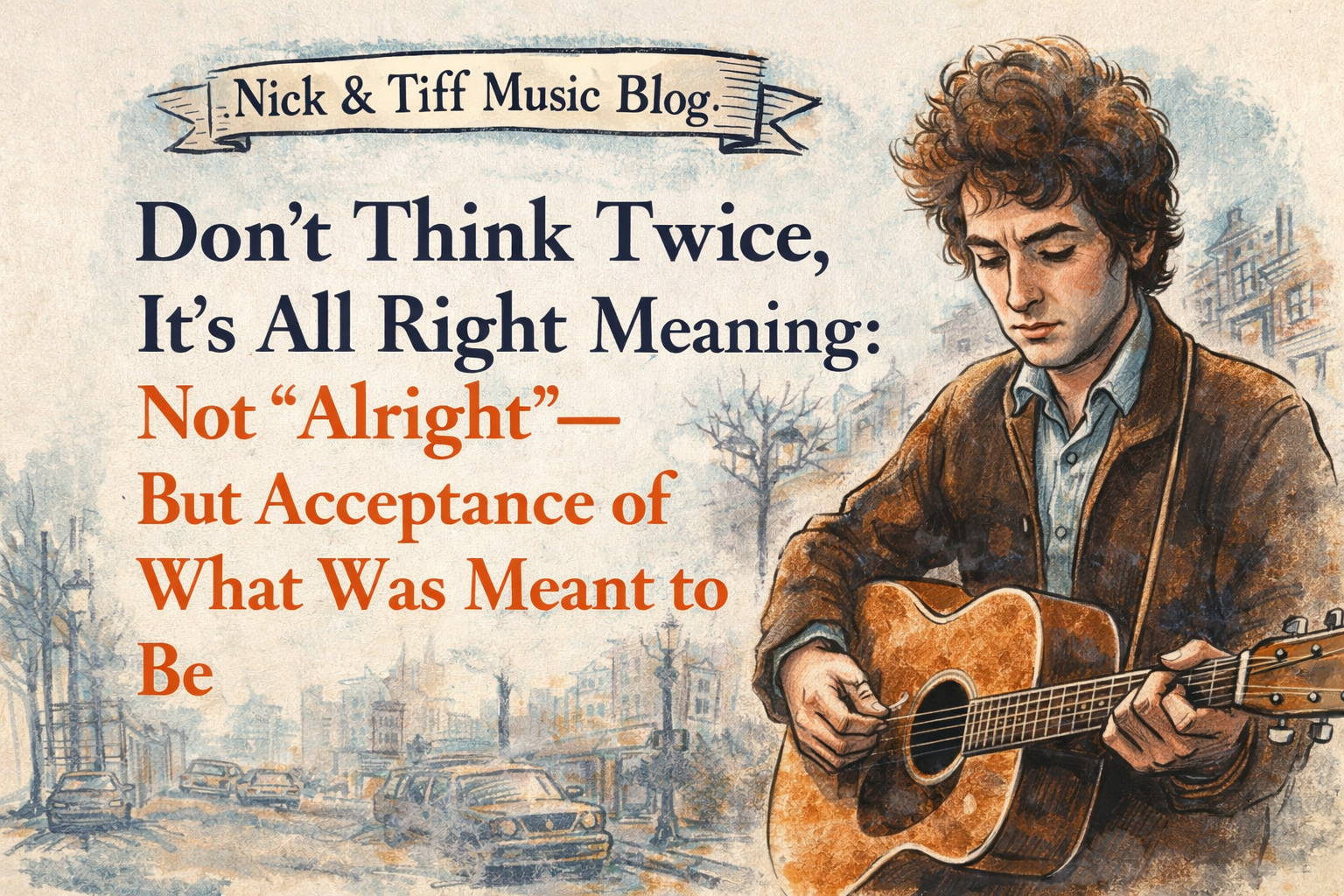
“Don’t Think Twice, It’s All Right” by Bob Dylan isn’t about everything being alright—it’s about something being all right.
That small difference changes everything.
It’s not a reassurance that things are okay. It’s an acceptance that things turned out the way they were always going to. The relationship didn’t just fall apart—it reached the ending it was meant to have.
Released in 1963 on The Freewheelin’ Bob Dylan, the song presents itself as a calm goodbye. But beneath that surface is something deeper: a narrator coming to terms with the idea that there’s no use overthinking what couldn’t have gone any other way.
Explore more of our Bob Dylan discussions, song meaning breakdowns, & album reviews here.
Quick Details
- Artist: Bob Dylan
- Song: Don’t Think Twice, It’s All Right
- Album: The Freewheelin’ Bob Dylan
- Released: 1963
- Written by: Bob Dylan
- Genre: Folk
What Is “Don’t Think Twice, It’s All Right” About?
At its core, the song is about leaving a relationship that isn’t working—but doing so with a sense of acceptance rather than dramatic heartbreak.
The narrator isn’t begging, arguing, or trying to fix things. Instead, he’s walking away while acknowledging that this outcome feels inevitable.
There’s no attempt to rewrite the past or imagine a different ending. In his mind, this is simply how it was always going to play out.
A Calm Goodbye That Hides Something Deeper
From the very first line—“It ain’t no use to sit and wonder why, babe…”—the narrator shuts down the idea of overthinking.
On the surface, it sounds like advice. But it also feels like a boundary.
He’s not interested in analyzing what went wrong, because doing so would imply that things could have turned out differently. And that’s not how he sees it.
Instead, he’s already reached a conclusion: this relationship ran its course, and there’s nothing left to figure out.
The Bitterness That Still Lingers
Even with that acceptance, the song isn’t free of emotion.
Lines like “You just kinda wasted my precious time” cut through the calm tone and reveal a layer of frustration underneath.
That’s what makes the song feel so real.
Acceptance doesn’t erase hurt—it just changes how it’s expressed.
Rather than letting his emotions spill over, the narrator chooses acceptance—keeping everything contained as he convinces himself this is simply how things were meant to end.
“All Right” vs. “Alright”: A Subtle but Crucial Difference
The title line—“Don’t think twice, it’s all right”—is where the song’s meaning really comes into focus.
It’s easy to hear it as “alright,” as if the narrator is saying everything is fine.
But the phrasing suggests something different.
It’s “all right” in the sense of:
- This is how things are
- This is how it was meant to happen
- This is the natural outcome
He’s not claiming happiness or even relief.
He’s acknowledging reality.
That subtle distinction shifts the entire emotional tone of the song. The line becomes less about reassurance and more about acceptance—almost like a quiet recognition that the relationship couldn’t have ended any other way.
And in that sense, the narrator isn’t just walking away—he’s accepting that this ending was inevitable.
Independence, Acceptance, and Moving On
As the song moves forward, there’s a clear sense of the narrator reclaiming his independence.
Leaving at the break of dawn, moving on without looking back—it all feels decisive.
But that decision isn’t driven by sudden clarity or empowerment. It comes from accepting that staying would go against what already feels set in motion.
He’s not chasing something new as much as he’s aligning himself with what he believes is meant to happen.
That’s what gives the song its quiet strength.
Where It Fits on The Freewheelin’ Bob Dylan
On an album known for its social commentary and protest songs, “Don’t Think Twice, It’s All Right” stands out as something deeply personal.
It slides in right after Dylan’s “A Hard Rain’s A-Gonna Fall” a very politically charged song.
It shows Dylan stepping away from the broader world and focusing on a smaller, more intimate moment—but one that feels just as universal.
Because while not everyone writes protest songs, almost everyone understands what it feels like to accept the end of something that once mattered.
Explore our full track-by-track breakdown of The Freewheelin’ Bob Dylan here:
The Freewheelin’ Bob Dylan (1963) – Bob Dylan | Album Review #12
Why the Song Still Connects Today
The song endures because it captures a very specific emotional space:
Not the initial heartbreak. Not full closure. But the moment in between—when you stop asking “why” and start accepting that there may not be an answer.
It’s about recognizing that some endings aren’t meant to be solved or fixed.
They’re just meant to be.
Support Nick & Tiff Music: As an affiliate these links help support the blog at no extra cost to you — and we truly appreciate it! Thank you for supporting.
Buy The Freewheelin’ Bob Dylan Vinyl & CD
Shop Bob Dylan Vinyl, CD, Books & Merch
Try and catch Dylan on Tour:
See Bob Dylan Tour Dates & Tickets
Final Thoughts
“Don’t Think Twice, It’s All Right” isn’t a song about everything turning out okay—it’s a song about realizing that things turned out the way they were always going to.
Bob Dylan delivers that realization with a calm, understated performance, but the emotional depth is unmistakable.
It’s not optimism. It’s not indifference.
It’s acceptance.
And in that quiet acceptance, the song finds its power.
FAQ “Don’t Think Twice, It’s All Right”
Is “Don’t Think Twice, It’s All Right” about a real relationship?
The song is often associated with Dylan’s early relationship with Suze Rotolo, though its themes go beyond any single experience.
Why does the song sound so calm?
The calm tone reflects acceptance rather than a lack of feeling. The narrator isn’t overwhelmed—he’s already made peace with the outcome.
What does “it’s all right” really mean in the song?
It doesn’t mean everything is okay. It suggests that this is simply how things were meant to happen, and there’s no use questioning it further.
Like, comment, or share — and let me know your take in the comments.
If you enjoyed this piece, you might enjoy our weekly music discussions, song meaning breakdowns, and full track-by-track album deep dives. You can subscribe below – it’s free.
Browse our articles by Bands & Artists:
Bands & Artists | Explore Music Coverage by Artist – Nick & Tiff Music Blog
Related Reads
What Is the Best Bob Dylan Album? A Look at the Legendary Songwriter’s Greatest Records
Highway 61 Revisited Album Review #32: Bob Dylan Changes Rock Music Forever
Tangled Up in Blue (1975) Meaning & Song Review – Bob Dylan
Simple Twist of Fate Meaning & Song Review — Bob Dylan (1975)
The Freewheelin’ Bob Dylan (1963) – Bob Dylan | Album Review #12
Ballad of a Thin Man (1965) Meaning & Song Review – Bob Dylan
Tombstone Blues Lyrics Meaning: Bob Dylan’s Surreal Satire Explained
Desolation Row Lyrics Meaning: Bob Dylan’s Surreal Masterpiece Explained
Pledging My Time Lyrics Meaning: Bob Dylan’s Devotion Turns Obsessive
A Hard Rain’s A-Gonna Fall – Bob Dylan (1963) Meaning & Song Review
From Dylan to Springsteen to Zach Bryan: The Lineage of the American Songwriter
Same Vibes #3: Nebraska & Blood on the Tracks
What Is the Best Beatles Album? A Look at Their Greatest Records
What Is the Best Bruce Springsteen Album? A Look at His Greatest Records
What Is the Best Neil Young Album? A Look at His Greatest Records
What Is the Best Led Zeppelin Album? Exploring the Band’s Greatest Records
Bruce Springsteen – Born to Run (1975) Album Review #4
Thunder Road (1975) – Meaning & Song Review – Bruce Springsteen
Zach Bryan – With Heaven on Top (2026) | Album Review #6
Zach Bryan – (Self-Titled) (2023) Album Review #5
Something in the Orange (2022) – Meaning & Song Review – Zach Bryan
The 10 Most Underrated Rolling Stones Songs (In Chronological Order)
Dead Flowers Meaning & Song Review — The Rolling Stones (1971)
The 10 Most Underrated Beatles Songs (In Chronological Order)
Why Revolver Is The Beatles’ Most Underrated Masterpiece
The Beatles – The White Album (1968) | Album Review #9
Check out our Song Review Archives page:
Song Reviews | Nick & Tiff Music Blog
Explore more on the Homepage:
Nick & Tiff Music Blog – ALBUM & SONG REVIEWS – GEAR TALK & STORE UPDATES
Leave a Reply